
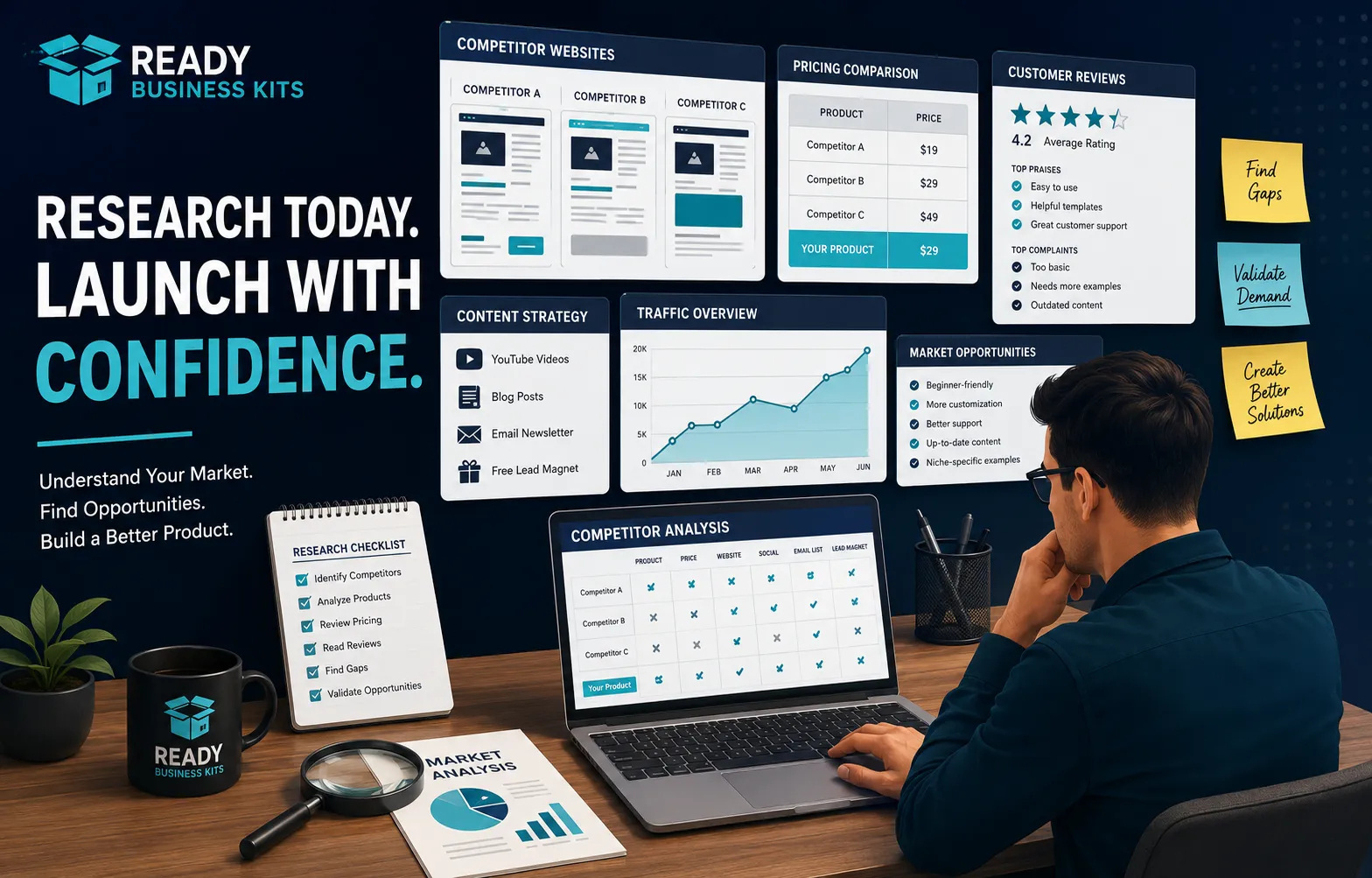
Quick answer: Research competitors before launching by identifying direct, indirect, and substitute competitors; comparing their products, audiences, pricing, positioning, reviews, strengths, and weaknesses; and looking for repeated customer problems that existing solutions do not handle well. Use those patterns to improve your own positioning—not to copy another seller.
This is especially important for digital products. Unlike physical products, digital products are inexpensive to create and distribute. That low barrier to entry attracts thousands of creators, which means many markets become crowded quickly. Buyers often have dozens—or even hundreds—of options.
The creators who succeed aren’t always the first to market. They’re the ones who understand what already exists, recognize what customers appreciate, identify legitimate weaknesses, and position their products accordingly.
Fortunately, effective competitor research doesn’t require expensive software or complicated analytics. Most of the information you need is already publicly available if you know where to look and what questions to ask.
This guide walks you through a practical competitor research process using free tools and publicly available information so you can launch with confidence instead of relying on assumptions.
Why Competitor Research Matters Before You Build Anything
Many new creators skip competitor research because they worry it will discourage them or make them doubt their ideas. In reality, the opposite is usually true.
Good research reduces uncertainty.
Instead of wondering whether people buy products like yours, you’ll know.
Instead of guessing what customers expect, you’ll see it.
Instead of pricing based on emotion, you’ll understand how the market is already positioned.
Competitor research helps answer questions such as:
- Is there already an active market?
- Who is currently serving that market?
- What formats do customers prefer?
- What price ranges appear common?
- What complaints appear repeatedly?
- What features do buyers consistently praise?
- What expectations have competitors already established?
These answers can influence nearly every business decision you make.
Without research, it’s easy to build something that is:
- Too similar to existing products
- Missing features buyers now expect
- Aimed at the wrong audience
- Difficult to differentiate
- Priced unrealistically
- Marketed with language that doesn’t resonate
Competitor research dramatically reduces these risks.
Just as importantly, research gives you confidence. When launch day arrives, you’ll know your product wasn’t built in isolation—it was built with an understanding of the marketplace.
Competition Is Usually a Good Sign
Many beginners become discouraged when they discover dozens of competing products.
In most cases, competition is actually encouraging.
A competitive market usually indicates that people are already spending money to solve that problem.
Markets with absolutely no competitors deserve closer investigation. Sometimes they represent opportunities. Other times they indicate insufficient demand.
Rather than asking:
“How can I find a market with no competition?”
Ask:
“How can I serve this market better or differently?”
That mindset produces far stronger businesses.
Understanding the Three Types of Competitors
One of the biggest mistakes beginners make is researching only businesses that sell nearly identical products.
Your customers compare far more options than you might realize.
Understanding all three types of competitors gives you a much more complete picture.
Direct Competitors
Direct competitors sell essentially the same type of product to the same audience.
For example, suppose you’re creating a printable bookkeeping workbook for freelance designers.
Direct competitors would include:
- Printable bookkeeping workbooks
- Freelancer accounting spreadsheets
- Digital bookkeeping planners
- PDF bookkeeping guides for freelancers
These businesses compete directly for the same customer.
Indirect Competitors
Indirect competitors solve the same problem using a different format.
Examples include:
- Online bookkeeping courses
- Coaching programs
- Accounting software
- Membership communities
- Financial consulting
Although these products look different, customers may compare them before deciding how to solve their bookkeeping problem.
Substitute Competitors
Substitutes are often overlooked but can be your biggest competition.
These include:
- Free YouTube tutorials
- Blog articles
- Reddit discussions
- AI assistants
- Templates from friends
- Existing spreadsheets
- Simply doing nothing
Many buyers ask themselves:
“Should I buy this?”
They’re actually asking:
“Is this better than what I’m already doing?”
Understanding substitute competitors helps you communicate why paying for your solution makes sense.
Building a Competitor Map
Before evaluating products, create a master list.
Separate competitors into three sections:
| Type | Examples |
|---|---|
| Direct | Similar products sold to the same audience |
| Indirect | Different solutions addressing the same problem |
| Substitute | Free resources, DIY methods, or no action |
Keeping these categories separate prevents you from overlooking important influences on customer buying decisions.
Where to Find Competitors Using Free Tools
You don’t need expensive market research platforms to understand your niche.
Most successful digital product creators begin with free resources.
Here are the most valuable places to look.
1. Google Search
Google remains one of the best research tools available.
Search using buyer-focused phrases instead of general topics.
Examples include:
- business startup template
- marketing workbook PDF
- social media planner download
- bookkeeping spreadsheet
- customer onboarding checklist
- Etsy pricing guide
- digital planner for freelancers
Also search phrases like:
- best ___ template
- best ___ workbook
- recommended ___ course
- top ___ planner
Study both organic results and sponsored listings.
Sponsored ads often indicate products that businesses believe are profitable enough to advertise consistently.
Don’t stop at the first few listings.
Review the first two pages of results to identify recurring names.
Repeated appearances often indicate established competitors.
2. Digital Product Marketplaces
Marketplaces provide valuable real-world information because they display products already being purchased.
Popular marketplaces include:
- Etsy
- Gumroad
- Creative Market
- Notion Marketplace
- Udemy
- Teachable
- Shopify app marketplaces (where applicable)
Study listings carefully.
Look at:
- Product titles
- Cover images
- Pricing
- Product descriptions
- Included bonuses
- Review counts
- Star ratings
- Frequently asked questions
These details reveal how sellers position their products and what buyers appear to value.
3. YouTube
YouTube isn’t just for learning.
It’s an outstanding competitor research platform.
Search your topic exactly as potential customers would.
Notice:
- Which creators appear repeatedly
- Which videos have strong engagement
- Which creators mention paid products
- Which lead magnets they promote
- Which questions viewers ask repeatedly
Pay particular attention to video comments.
Questions asked repeatedly often highlight customer confusion, unmet needs, or buying concerns.
4. Pinterest
Pinterest remains an excellent discovery platform for planners, printables, templates, checklists, worksheets, and other downloadable products.
Search using your product idea.
Study:
- Popular designs
- Recurring topics
- Frequently saved pins
- Landing pages
- Product categories
Pinterest also reveals seasonal opportunities you may otherwise overlook.
5. Social Media
Search relevant keywords on:
- TikTok
Look beyond follower counts.
Instead, evaluate:
- Engagement
- Comments
- Questions
- Product demonstrations
- Customer testimonials
- Educational content
- Calls to action
Strong engagement often indicates that creators understand their audience well.
6. Online Communities
Communities often contain the most honest customer feedback available.
Places worth exploring include:
- Facebook Groups
- Industry forums
- Quora
- Discord communities (where publicly accessible)
Search for discussions such as:
- Best budgeting template
- Favorite business planner
- Worth buying?
- Has anyone used…
- Looking for recommendations
Community conversations often reveal frustrations that sales pages never mention.
7. Ask Real Customers
One of the simplest research methods is also one of the most overlooked.
Talk to people.
Ask members of your target audience questions like:
- What do you currently use?
- What have you purchased?
- What did you like?
- What disappointed you?
- What do you wish existed?
You don’t need dozens of interviews.
Even a handful of thoughtful conversations can reveal valuable insights that no software tool can provide.
Organizing Your Research
As you discover competitors, resist the temptation to rely on memory.
Instead, create a spreadsheet from the beginning.
Include columns such as:
- Company
- Product
- Website
- Format
- Audience
- Price
- Bonuses
- Guarantee
- Reviews
- Strengths
- Weaknesses
- Notes
Your spreadsheet becomes a living research document that you can update over time.
More importantly, patterns begin to emerge once several competitors are listed side by side.
Those patterns often become the foundation of your own positioning strategy.
What to Study Once You’ve Found Competitors
Finding competitors is only the beginning. The real value comes from understanding how they position, package, and sell their products.
Your goal isn’t to admire successful businesses or criticize weak ones. Your goal is to gather evidence that helps you make better decisions for your own product.
Choose five to ten competitors that closely relate to your idea and evaluate each using the same criteria.
Product Format
Start by identifying exactly what they’re selling.
Examples include:
- PDF guides
- Workbooks
- Checklists
- Notion templates
- Excel spreadsheets
- Canva templates
- Printable planners
- Video courses
- Memberships
- Bundles
- Coaching programs
Different formats command different prices and appeal to different buyers. Understanding these patterns helps you choose a format that matches customer expectations while fitting your expertise.
Positioning
Pay close attention to how competitors describe their products.
Ask yourself:
- Who is this product for?
- What problem does it claim to solve?
- What outcome does it promise?
- What makes it different?
Notice the language they use repeatedly.
For example:
- “Perfect for beginners”
- “Done-for-you templates”
- “Save hours every week”
- “No design experience required”
You’re not collecting phrases to copy. You’re identifying the problems customers appear to care about most.
Target Audience
Strong competitors speak directly to a specific audience.
Examples include:
- Freelancers
- Coaches
- Realtors
- Etsy sellers
- Local service businesses
- Teachers
- Small business owners
If every competitor targets everyone, there may be an opportunity to specialize.
Specific audiences often respond better to products that clearly address their unique situations.
Pricing
Record the actual selling price.
Also note:
- Sales
- Discounts
- Bundles
- Subscription options
- Payment plans
After reviewing several competitors, you’ll usually discover a natural pricing range.
This range doesn’t determine what you should charge, but it provides valuable context.
Promises
Nearly every product promises a result.
Examples include:
- Save time
- Increase sales
- Stay organized
- Grow your business
- Reduce stress
- Learn faster
Ask yourself:
Are these promises believable?
Do customers appear satisfied with those promises?
Do reviews support those claims?
Bonuses
Many digital products include extras such as:
- Checklists
- Templates
- Worksheets
- Resource libraries
- Video tutorials
- Email support
- Private communities
Sometimes the bonus package creates more perceived value than the core product itself.
Guarantees
Does the seller offer:
- A refund policy?
- A satisfaction guarantee?
- Customer support?
- Product updates?
Guarantees reduce buyer hesitation and increase trust.
Learning from Customer Reviews
Reviews are one of the most valuable forms of competitor research because they come directly from customers.
Read both positive and negative reviews.
Many creators only read five-star reviews.
That’s a mistake.
You learn just as much—often more—from lower ratings.
Look for Repeating Praise
Instead of focusing on individual comments, look for recurring themes.
Examples include:
- Easy to follow
- Saved me time
- Beautiful design
- Worth every penny
- Very practical
- Excellent support
When dozens of buyers repeat similar compliments, you’ve identified something customers genuinely value.
Look for Repeating Complaints
Negative reviews often reveal opportunities.
Examples include:
- Too basic
- Confusing instructions
- Poor organization
- Outdated information
- Missing examples
- Difficult to customize
- Slow customer support
One complaint isn’t meaningful.
Twenty similar complaints deserve attention.
Patterns matter.
Read Customer Questions
Many marketplaces allow customers to ask questions before buying.
These questions often reveal uncertainty that competitors haven’t addressed.
Examples include:
- Is this beginner friendly?
- Does it work with Canva Free?
- Can I edit it?
- Is commercial use included?
- Will this work on a Mac?
If buyers repeatedly ask the same questions, consider answering them clearly on your own sales page.
Identifying Genuine Market Gaps
One of the biggest misconceptions about competitor research is believing every gap represents an opportunity.
It doesn’t.
Sometimes competitors avoid certain features because customers don’t want them.
Sometimes they’re difficult to deliver profitably.
Sometimes they’re legally or technically complicated.
Instead of asking:
“What doesn’t exist?”
Ask:
“What do customers repeatedly wish existed?”
That’s a much stronger question.
Finding a possible market gap is only the beginning. Before investing heavily in the product, use How to Validate a Digital Product Idea Before You Build It to determine whether qualified buyers will actually take meaningful action.
Evidence-Based Gaps
Strong opportunities are supported by evidence such as:
- Repeated review requests
- Common complaints
- Community discussions
- Frequently asked questions
- Multiple competitors missing the same feature
For example:
If dozens of reviews mention:
“I wish this workbook included completed examples.”
That’s meaningful.
If only you think examples would be nice, that’s simply an idea—not market evidence.
Using Reviews Ethically
Customer reviews are excellent research material.
They’re not marketing copy.
Ethical research includes:
- Identifying recurring problems
- Learning customer language
- Understanding expectations
- Discovering unmet needs
Avoid:
- Copying customer testimonials
- Reusing review wording
- Taking screenshots without permission
- Reproducing competitor content
Use reviews to understand customers—not to imitate competitors.
Pricing Without Becoming the Cheapest
New creators often assume lower prices automatically attract more customers.
That’s rarely true.
Price communicates value.
Products priced far below competitors may actually reduce buyer confidence.
Instead:
- Identify the pricing range.
- Compare what’s included.
- Evaluate the depth of the product.
- Consider bonuses.
- Price according to value.
For example:
| Product | Price |
|---|---|
| Checklist | $9 |
| Workbook | $29 |
| Template Bundle | $49 |
| Complete Course | $149 |
Notice that higher prices usually reflect greater depth, additional resources, ongoing support, or more comprehensive outcomes.
Competing solely on price often leads to lower profits and weaker positioning.
Study the Entire Sales Process
Your competitors are selling more than a product.
They’re selling an experience.
Study how they attract visitors and convert them into customers.
Sales Pages
Evaluate:
- Headlines
- Opening paragraphs
- Problem statements
- Benefits
- Features
- Testimonials
- Guarantees
- Calls to action
Notice the overall structure rather than individual wording.
Lead Magnets
Many businesses offer free resources such as:
- Checklists
- Cheat sheets
- Mini guides
- Templates
- Email courses
Lead magnets reveal what competitors believe is valuable enough to exchange for an email address.
Email Funnels
Consider subscribing to competitors’ email lists using a dedicated email account.
Observe:
- Welcome emails
- Educational content
- Promotions
- Product launches
- Discounts
- Follow-up timing
You’re studying customer experience—not collecting copy.
Content Marketing
Review their:
- Blog
- YouTube channel
- Podcast
- Pinterest account
- LinkedIn posts
- TikTok
Ask:
What topics appear repeatedly?
Which content receives the most engagement?
Which articles seem to generate product sales?
Understanding these patterns can help shape your own content strategy.
Build a Competitor Research Spreadsheet
Once you’ve collected enough information, organize everything in one place.
Suggested columns include:
- Competitor
- Website
- Product Name
- Format
- Target Audience
- Price
- Core Promise
- Bonuses
- Refund Policy
- Reviews
- Common Praise
- Common Complaints
- Lead Magnet
- Email Sequence
- Strengths
- Weaknesses
- Positioning Notes
- Opportunities
Review the spreadsheet as a whole rather than focusing on individual competitors.
Patterns across multiple businesses provide much stronger evidence than isolated observations.
Create a Simple Competitor Scorecard
After gathering your research, rate each competitor using consistent criteria.
| Criteria | Score (1–5) |
|---|---|
| Product Quality | |
| Value for Price | |
| Sales Page | |
| Trust Signals | |
| Customer Reviews | |
| Ease of Understanding | |
| Overall Impression |
This isn’t a scientific measurement.
It’s simply a structured way to compare competitors objectively.
Look for Underserved Audiences
Sometimes the opportunity isn’t creating a better product.
It’s serving a different audience.
Ask yourself:
- Are beginners overlooked?
- Are retirees ignored?
- Are local businesses underserved?
- Are non-technical users struggling?
- Are solo entrepreneurs overlooked?
A specialized product often competes more effectively than a general one.
Develop Your Positioning Statement
After completing your research, summarize your findings in one sentence.
A useful format is:
For [specific audience] who struggle with [problem], this product helps them [desired outcome], unlike [general competitor category], which [common limitation].
If your positioning statement is based on genuine research rather than assumptions, your marketing becomes much stronger.
Common Competitor Research Mistakes
Avoid these common mistakes:
- Researching only direct competitors.
- Ignoring free alternatives.
- Assuming every gap represents demand.
- Copying pricing without understanding value.
- Reading only positive reviews.
- Never joining competitor email lists.
- Failing to organize research.
- Conducting research once and never updating it.
Competitor research should be an ongoing process rather than a one-time exercise.
Turn Your Research Into a Real Validation Test
Competitor research can show you what already exists, what customers value, and where possible opportunities may be hiding. The next step is testing whether real buyers respond to your specific offer.
The 7-Day Offer Validation & Launch System gives you a structured process for organizing your assumptions, researching demand, testing the offer, and deciding whether to move forward before investing heavily in production.
See the 7-Day Offer Validation & Launch System →
Conclusion
Competitor research isn’t about copying successful businesses. It’s about understanding the market well enough to make informed decisions.
By studying competitors ethically, organizing your findings, identifying genuine customer needs, and positioning your product thoughtfully, you dramatically improve your chances of creating something buyers actually want.
Remember that your goal isn’t to build a product that’s merely different. It’s to build one that’s more useful, more relevant, and better aligned with customer needs than the alternatives already available.
The strongest digital products are rarely created by guessing. They’re built by listening to the market, learning from existing solutions, and delivering meaningful improvements where they matter most.
Ready to turn your competitor research into a real validation plan? The 7-Day Offer Validation & Launch System gives you a structured process for testing your audience, clarifying your offer, gathering market feedback, and preparing a practical launch plan before you invest heavily in building.