
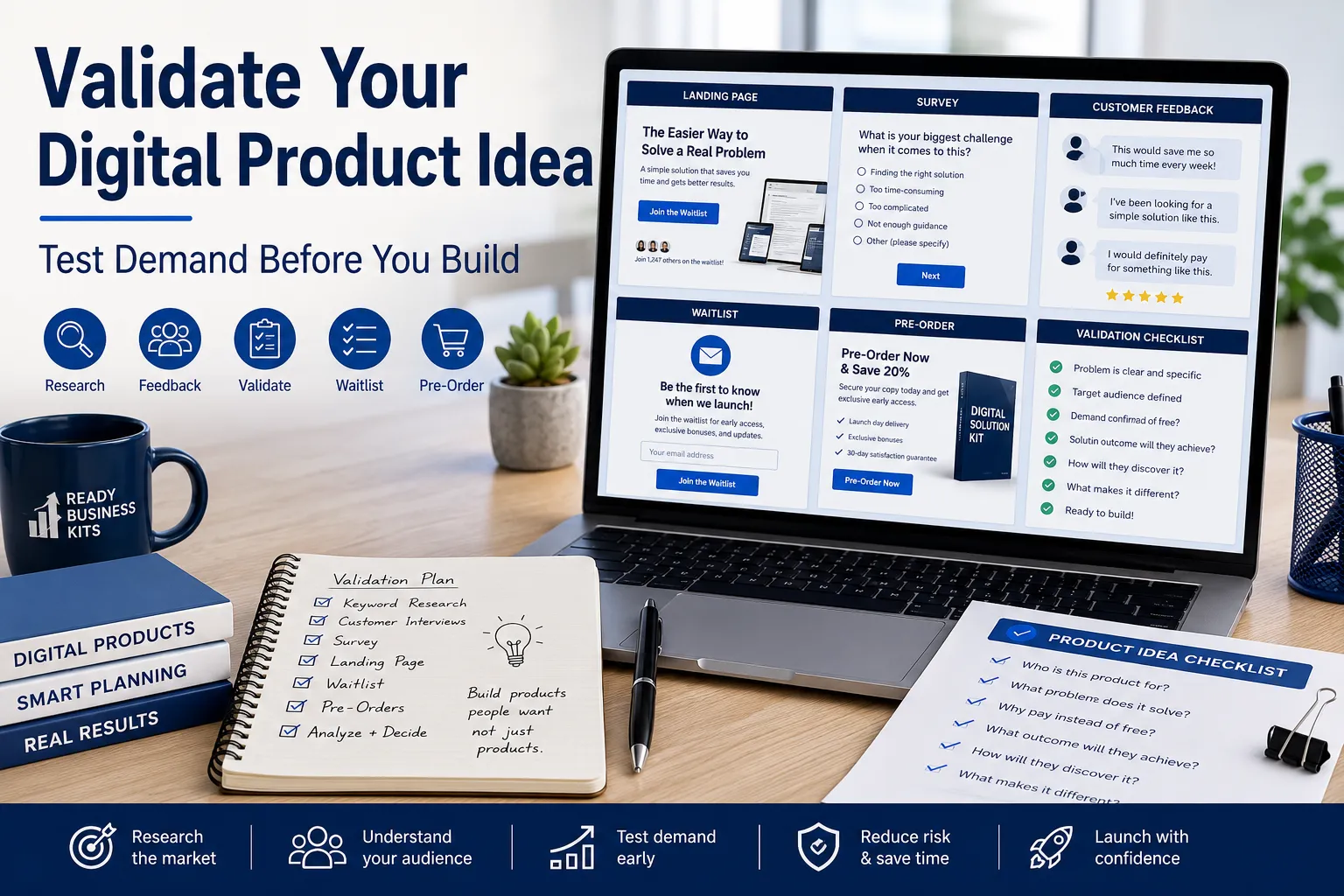
Quick answer: Validate a digital product idea by defining a specific buyer and problem, checking for existing demand, studying competing solutions, talking with potential customers, and testing whether people will take meaningful action such as joining a waitlist, requesting access, placing a preorder, or making a purchase. Build the full product only after the evidence is strong enough to justify the investment.
Most digital products do not fail because they are badly written, poorly designed, or technically difficult to use. They fail because the creator built something before confirming that enough people wanted it.
It is easy to become attached to an idea. You imagine the finished ebook, template bundle, online course, membership, workbook, or software tool. You start choosing colors, creating modules, designing covers, and planning a launch.
Weeks later, the product is finished—but sales never arrive.
The instinct is often to blame the price, the sales page, the marketplace, the algorithm, or the lack of advertising. Sometimes those things contribute to weak results. But the most damaging mistake may have happened before the product was created: the idea was never properly validated.
Product validation helps you determine whether a real audience has a real problem, is actively looking for a solution, and is willing to take meaningful action to obtain it.
That action might be:
- Joining a waiting list
- Requesting more information
- Downloading a related resource
- Applying to become a beta tester
- Reserving early access
- Paying a deposit
- Placing a pre-order
- Purchasing a smaller version of the product
The closer the action comes to an actual purchase, the stronger the evidence becomes.
Validation does not guarantee that a product will succeed. Nothing can provide that guarantee. It does, however, reduce the likelihood that you will spend weeks or months creating something based entirely on assumptions.
This guide explains how to validate a digital product idea before you build it, how to recognize meaningful evidence, which testing methods to use, and how to decide whether to proceed, revise the offer, or abandon the idea.
Key Takeaways
Before creating a digital product, remember these principles:
- Interest is not the same as purchase intent.
- Compliments from friends and family are weak evidence.
- Search activity can reveal demand, but it does not prove that people will pay.
- Customer interviews should focus on actual experiences rather than hypothetical opinions.
- Existing competition can confirm that buyers already spend money in the market.
- A landing page, waiting list, beta offer, or pre-order can test the strength of your offer.
- Validation should test the audience, problem, promise, format, price, and path to reaching buyers.
- A failed validation test can save you from building the wrong product.
- The strongest evidence usually comes from observable behavior—especially payment.
What Does It Mean to Validate a Digital Product Idea?
Digital product validation is the process of gathering evidence that a particular group of people wants the solution you are considering creating.
You are not merely trying to prove that the general topic is popular. You are testing whether:
- A clearly defined audience experiences the problem.
- The problem is important enough for them to address.
- People are already searching for or purchasing solutions.
- Your proposed product offers a useful outcome.
- Buyers understand the offer.
- You can reach those buyers through realistic marketing channels.
- Some of them are willing to take action.
The U.S. Small Business Administration recommends combining market research with competitive analysis to identify customers and develop a competitive advantage. Its suggested direct-research methods include surveys, questionnaires, focus groups, and in-depth interviews.
Validation goes one step further than general market research. Market research may show that a category exists. Validation tests the assumptions behind your specific product.
For example, market research might confirm that freelancers purchase business templates. Validation would test whether freelance graphic designers want a particular client-onboarding template bundle, understand its value, prefer its format, and will pay the proposed price.
That distinction matters.
A large market does not automatically create demand for every product introduced into it. Your particular offer still needs to solve the right problem for the right audience in the right way.
Assumptions Are Not Evidence
Creators often move forward based on statements such as:
- “People need this.”
- “There is nothing else like it.”
- “Everyone I know thinks it is a great idea.”
- “I would buy it.”
- “My social media post received a lot of likes.”
- “This topic is trending.”
- “A competitor is charging $97, so I can sell mine for $47.”
- “People are always asking questions about this.”
These observations may justify further research, but they do not prove that your offer will sell.
A useful validation process separates assumptions from evidence.
| Assumption Stronger Evidence | |
|---|---|
| People probably struggle with this problem. | Members of the target audience repeatedly describe the problem in their own words. |
| People search for information about the topic. | Search data shows continuing interest in solution-focused queries. |
| People would probably pay for help. | Buyers already purchase related products or services. |
| The proposed format seems convenient. | Potential customers choose that format when given realistic alternatives. |
| The price appears reasonable. | Qualified prospects join a paid beta, place pre-orders, or purchase an MVP. |
| Friends say the idea sounds excellent. | People with no personal relationship to the creator take measurable action. |
| Social media engagement proves demand. | Visitors move from a post to a landing page and complete the intended call to action. |
Strategyzer’s business-testing guidance similarly distinguishes opinions from stronger behavioral evidence. Customer interviews can uncover important information, but interviews alone remain weaker than tests in which people behave as though they are making a genuine purchasing decision.
The goal is not to eliminate every uncertainty. That is impossible. The goal is to replace your most important guesses with enough evidence to make a better business decision.
Why Product Validation Is Worth the Effort
Some creators resist validation because they believe it delays the launch.
In reality, building the wrong product usually creates a much longer delay.
A digital product may require:
- Research
- Writing
- Designing
- Recording
- Editing
- Formatting
- Testing
- Uploading
- Creating product images
- Writing sales copy
- Building emails
- Preparing customer support materials
Even a relatively simple template bundle can consume many hours when it is created professionally.
Validation protects that investment.
It Helps Prevent Wasted Work
The most immediate benefit is avoiding months of work on a product that solves an unimportant problem.
A weak validation result does not necessarily mean the entire idea is worthless. It may reveal that the audience is too broad, the promise is unclear, the format is inconvenient, or the proposed price does not match the perceived value.
Those problems are far easier to correct before the product has been completed.
It Reveals What Customers Actually Want
You may begin with the idea of creating a 100-page ebook and discover that the audience wants a fill-in-the-blank workbook.
You may plan an advanced course and learn that buyers need a beginner-friendly checklist.
You may assume customers want more information when they really want a faster implementation system.
You may believe price is their biggest concern when their real concern is whether they can use the product without special software or technical knowledge.
Validation allows the product to be shaped by actual customer needs instead of the creator’s personal preferences.
It Improves Your Marketing Message
Customer research does more than guide product development. It reveals the words buyers use when describing their situation.
Those words can improve:
- Headlines
- Product names
- Sales-page copy
- Email subject lines
- Calls to action
- Product descriptions
- Frequently asked questions
- Advertising messages
A creator might describe a product as a “comprehensive client acquisition framework.”
The intended customer might say:
“I need a simple way to find clients without spending all day sending messages.”
The customer’s version is clearer, more specific, and more emotionally relevant.
It Helps You Establish a Realistic Price
Validation can expose the difference between the price you want to charge and the value buyers believe they will receive.
That does not mean you should automatically lower the price when someone objects. Price resistance may indicate that:
- The wrong audience is seeing the offer.
- The outcome is not clearly explained.
- The problem is not urgent.
- The product appears too generic.
- The format does not fit the buyer’s needs.
- The offer lacks proof or credibility.
- A free alternative appears sufficient.
The purpose of price testing is not to discover the lowest amount people will pay. It is to determine whether the product’s perceived value supports a profitable price.
It Builds an Early Audience
A validation campaign can also become the beginning of your launch audience.
People who join a waiting list, answer a survey, participate in an interview, or test a beta product may later become:
- Early customers
- Reviewers
- Testimonial providers
- Referral partners
- Affiliates
- Repeat buyers
- Sources of future product ideas
Validation is therefore not separate from marketing. When handled correctly, it is the first stage of marketing.
The Evidence Ladder: Not All Validation Is Equal
Validation evidence can be arranged from weakest to strongest.
Level 1: Passive Attention
Examples include:
- Likes
- Views
- Impressions
- Reactions
- Casual compliments
- Poll votes
These signals show that someone noticed the idea. They do not show that the person has the problem or would pay for a solution.
Level 2: Expressed Interest
Examples include:
- Survey responses
- Interview participation
- Comments describing the problem
- Direct messages asking questions
- Requests for additional information
This is more useful because the person is investing attention and sharing information. However, people can express interest without intending to purchase.
Level 3: Intentional Action
Examples include:
- Joining a specific waiting list
- Providing an email address for early access
- Applying to test the product
- Booking a discovery call
- Completing a detailed qualification form
- Downloading a closely related lead magnet
The person is now taking an action connected to the proposed solution.
Level 4: Commitment
Examples include:
- Agreeing to participate in a beta
- Attending a live demonstration
- Completing an onboarding process
- Providing detailed feedback on a prototype
- Referring another potential buyer
- Reserving a limited spot
Commitment requires more time or effort and therefore provides stronger evidence.
Level 5: Payment
Examples include:
- Paying a deposit
- Purchasing an MVP
- Joining a paid beta
- Placing a pre-order
- Purchasing the full product
Payment is generally the strongest evidence because the customer is giving up something of value to receive the promised solution.
This does not mean you should begin every validation process by accepting pre-orders. You may need to understand the problem, audience, and offer before requesting payment.
The important point is that evidence should become stronger as you move closer to building the complete product.
Step 1: Define the Audience, Problem, and Outcome
Before researching keywords, creating surveys, or building a landing page, clarify the idea you intend to test.
A vague idea produces vague evidence.
Consider the difference between these two concepts:
A business-planning product for entrepreneurs.
And:
A fill-in-the-blank one-page business-planning workbook for first-time digital-product creators who feel overwhelmed by traditional business plans.
The second concept identifies:
- The audience: first-time digital-product creators
- The problem: feeling overwhelmed by traditional plans
- The format: fill-in-the-blank workbook
- The scope: one-page plan
- The desired outcome: a simple, completed business plan
Use the following formula:
I want to help [specific audience] solve [specific problem] so they can achieve [specific outcome] using.

For example:
I want to help independent consultants who struggle to write proposals create professional client proposals faster using a customizable proposal template kit.
This statement is not your final sales copy. It is a testable hypothesis.
Strategyzer recommends defining assumptions precisely enough that they can be tested, including assumptions about customer segments, value propositions, channels, revenues, and costs.
Questions to Answer Before Testing
Write down clear answers to the following:
Who is the product for?
Avoid answers such as “entrepreneurs,” “parents,” “coaches,” or “small businesses.” Narrow the audience until you can picture the person encountering the problem.
What problem does the product solve?
Describe the problem as the customer experiences it. Do not describe your product features.
How frequently does the problem occur?
Recurring problems often create stronger opportunities than problems encountered once and quickly forgotten.
What happens if the problem remains unsolved?
The consequences may involve lost time, lost revenue, frustration, uncertainty, embarrassment, missed opportunities, or unnecessary expense.
What outcome does the buyer want?
The desired outcome should be concrete enough that the customer can recognize improvement.
Why might someone pay instead of using free information?
The product may save time, organize scattered information, provide customization, reduce errors, supply professional examples, or offer a complete implementation system.
How is the problem currently being handled?
Existing workarounds reveal both competition and opportunity.
Do not continue until you can explain the idea in plain language. If potential buyers cannot quickly understand what the product helps them accomplish, the validation results will be difficult to interpret.
Step 2: Look for Existing Market Demand
Once the idea is defined, investigate whether people are already looking for related solutions.
The SBA recommends examining demand, market size, location, market saturation, and the prices customers currently pay for alternatives.
For a digital product, useful demand signals include:
- Relevant Google searches
- YouTube searches
- Marketplace listings
- Product reviews
- Forum discussions
- Social media questions
- Community conversations
- Competing newsletters
- Paid courses or memberships
- Service providers solving the problem manually
Use Search Engines to Study Intent
Begin by searching for phrases a potential customer might use.
For example, someone validating a client-proposal template might search:
- How to write a freelance proposal
- Freelance proposal template
- Client proposal example
- Consulting proposal template
- How much should I include in a proposal?
- Best software for creating proposals
- Free proposal template
Pay attention to the intent behind each phrase.
A broad search such as “freelancing” shows general interest.
A search such as “customizable freelance proposal template” is closer to a product or purchase decision.
Look for phrases that suggest the person wants to:
- Solve a problem
- Complete a task
- Compare options
- Download a tool
- Purchase a template
- Save time
- Avoid a mistake
- Achieve a particular outcome
Google explains that Google Trends can help businesses understand how people search for information and whether interest in a topic is rising, falling, stable, or seasonal.
However, Google Trends reports relative search interest, not exact sales demand. Use it as one signal rather than treating it as proof that people will purchase your product.
Study Repeated Questions
Search Google, YouTube, Reddit, Facebook groups, Quora, specialized forums, and professional communities for questions related to the idea.
Repeated questions are especially useful.
One isolated complaint may represent an individual preference. The same complaint appearing across multiple independent sources suggests a broader pattern.
Record:
- The exact question
- Where it appeared
- How recently it was posted
- How frequently similar questions appear
- How people currently solve the problem
- Which recommendations they receive
- What they dislike about existing solutions
Do not enter groups and immediately promote your idea. Observe first. Follow community rules and use conversations as research, not as an excuse to advertise.
Examine Marketplace Demand
Depending on the product, investigate marketplaces such as:
- Etsy
- Amazon
- Udemy
- Gumroad
- Creative Market
- App marketplaces
- WordPress plugin directories
- Template marketplaces
- Industry-specific platforms
You may not be able to confirm exact sales for every listing. Do not invent them.
Instead, look for observable evidence:
- Number and recency of reviews
- Multiple sellers offering related products
- Products that have remained available over time
- Repeated product formats
- Common price ranges
- Frequently promised outcomes
- Customer complaints
- Requests for missing features
- Products bundled together
- Questions buyers ask before purchasing
Competition is not automatically a negative signal. Existing sellers can demonstrate that buyers already spend money to solve the problem.
A market with no competition might represent an overlooked opportunity. It might also indicate that buyers do not consider the problem important enough to pay for. Validation helps you determine which explanation is more likely.
Step 3: Identify Current Alternatives and Workarounds
Your product will compete with more than products that look exactly like it.
Customers may currently solve the problem by:
- Using a free template
- Watching YouTube tutorials
- Hiring a freelancer
- Purchasing consulting
- Building their own spreadsheet
- Combining several inexpensive tools
- Asking an AI assistant
- Reusing an old document
- Ignoring the problem
- Continuing with an inefficient manual process
These are all competitors because they compete for the customer’s time, money, and attention.
Suppose you want to create a social media content-planning system. Your competition includes:
- Other content calendars
- Project-management software
- Spreadsheet templates
- AI writing tools
- Social scheduling platforms
- Marketing agencies
- Free downloadable calendars
- The customer’s current notebook
Ask potential buyers:
- How do you handle this now?
- What have you already tried?
- What did you pay for?
- What worked?
- What was frustrating?
- Why did you stop using it?
- What do you wish were easier?
- What would make switching worthwhile?
The answers help you determine whether your product must be faster, easier, more specialized, more complete, or better supported.
Do not assume that every complaint represents a profitable opportunity. Customers may complain about a missing feature but remain unwilling to pay for it. Treat complaints as possible hypotheses that require further testing.
Step 4: Conduct Customer Discovery Interviews
Customer interviews help you understand the problem before asking people to evaluate your proposed solution.
The purpose is not to persuade participants that your idea is good. It is to learn how they currently behave.
Interview people who closely resemble the audience you intend to serve. Friends and relatives may participate when they genuinely match that audience, but personal relationships can make honest criticism less likely.
Ask About the Past, Not an Imaginary Future
Avoid questions such as:
- Would you buy this?
- Do you think this is a good idea?
- Would this feature be helpful?
- How much would you pay for something like this?
- Would you use a product that solved this problem?
These questions encourage speculation and politeness.
Instead, ask:
- Tell me about the last time you experienced this problem.
- What caused it?
- What did you do next?
- Which solution did you try?
- How long did the process take?
- Did you spend money trying to fix it?
- What was most frustrating?
- What happened when the solution did not work?
- How are you handling the problem today?
- Have you looked for another solution?
Past behavior is generally more informative than a hypothetical promise.
Listen for Strong Problem Signals
Pay attention when participants:
- Describe the problem without prompting
- Use emotional or urgent language
- Explain repeated attempts to solve it
- Mention spending money
- Describe a costly workaround
- Express dissatisfaction with available solutions
- Ask when your solution will be available
- Request to participate in a future test
Also pay attention to weak signals.
If participants rarely encounter the problem, do not actively search for solutions, and experience no meaningful consequences from leaving it unresolved, the idea may need to be repositioned.
Take detailed notes, but do not force every conversation to support your original idea.
The purpose of validation is to discover the truth early enough to act on it.
Step 5: Test the Offer With Real Buyer Action
People saying they like an idea is useful feedback, but validation becomes stronger when they take an action.
Useful tests include:
- Joining a targeted waiting list
- Requesting early access
- Applying for a beta
- Downloading a closely related resource
- Placing a pre-order
- Paying a deposit
- Purchasing a minimum viable version of the product
Choose the smallest realistic test that brings the potential customer closer to an actual buying decision. Track what people do, not only what they say.
The goal is not to build the entire product before testing. It is to create enough of the offer for a qualified buyer to understand the problem, promised outcome, format, and next step.
For example, you might create a simple landing page describing the proposed product and invite qualified prospects to join an early-access list. For stronger evidence, you might offer a limited paid beta, accept a deposit, or sell a minimum viable version.
Measure the actions that matter for the test, such as:
- Landing-page visits
- Email sign-ups
- Beta applications
- Replies from qualified prospects
- Pre-orders
- Deposits
- Purchases
A large number of visitors with very little meaningful action may indicate that the audience, message, offer, format, or price needs to be revised.
Step 6: Set a Decision Rule and Evaluate the Evidence
Before running the test, decide what result will cause you to proceed, revise the offer, test again, or stop.
Review the evidence across several areas:
- Does the intended audience repeatedly experience the problem?
- Are people already trying to solve it?
- Is there evidence of existing demand?
- Do buyers understand the promised outcome?
- Will qualified prospects take meaningful action?
- Can the product be sold at a price that supports the business?
- Can you realistically reach the audience?
A strong result supports moving forward.
A mixed result usually means refining the audience, offer, format, message, price, or traffic source and testing again.
A weak result can prevent you from investing additional time in the wrong product.
Do not judge the test only by whether it produced the result you hoped for. Compare the outcome with the decision rule you established before the test began.
The purpose of validation is not to prove that the original idea was correct. It is to gather enough evidence to make the next business decision with less uncertainty.
Validation Mistakes That Create False Confidence
Validation only works when the evidence is interpreted honestly. Several common mistakes can make a weak idea appear stronger than it really is.
Asking Leading Questions
A leading question encourages the answer you want to hear.
For example:
Wouldn’t it be helpful to have a complete system that solves this problem?
Most people will agree because the question makes disagreement feel unreasonable.
Use neutral questions instead:
- How do you currently solve this problem?
- What is difficult about your current process?
- What have you already tried?
- What happened the last time this problem occurred?
- What would need to improve for you to change solutions?
Your goal is to learn, not to receive approval.
Depending on Friends and Family
Friends and relatives usually want to encourage you. Their support is valuable personally, but it may not be reliable business evidence.
They may:
- Avoid criticizing the idea
- Say they would buy without intending to do so
- Misunderstand the intended audience
- Support you because of the relationship
- Have no experience with the problem
Their feedback becomes more useful when they genuinely match the target customer and have experienced the problem you are trying to solve.
Confusing Compliments With Demand
Statements such as these sound positive:
- “That is a great idea.”
- “You should definitely create that.”
- “People would love this.”
- “I would probably buy it.”
- “That could be very successful.”
None of them requires action.
Treat compliments as encouragement, not validation.
Stronger signals include:
- Joining a specific waiting list
- Completing a detailed survey
- Requesting beta access
- Paying a deposit
- Purchasing an MVP
- Placing a pre-order
Testing With the Wrong Audience
An offer can appear weak simply because it was shown to people who do not need it.
A proposal kit for independent consultants should not be validated primarily with general consumers. A meal-planning system for busy parents should not be judged based on responses from people who rarely cook.
Before interpreting the result, ask:
- Did these people match the intended customer?
- Did they experience the problem?
- Were they responsible for purchasing the solution?
- Could they realistically use the product?
- Did the traffic source attract qualified visitors?
Poor targeting can make a strong offer appear weak.
Testing Only the Topic
A popular topic does not guarantee that a specific product will sell.
People may search for a subject because they want:
- Free information
- Entertainment
- Definitions
- News
- Inspiration
- A quick answer
- A service instead of a product
Validate the actual offer, not only the popularity of the general subject.
Building Too Much Before Testing
Creators often produce the course outline, design the templates, record videos, and build the sales page before speaking with customers.
That reverses the process.
Begin with the most uncertain assumptions:
- Is the problem important?
- Does the audience actively seek solutions?
- Will people pay?
- Is the product format useful?
- Can the audience be reached?
Test those assumptions before investing in polish.
Ignoring Negative Feedback
Validation loses its value when you only accept information that supports the original idea.
Negative feedback may reveal:
- The problem is not urgent
- The offer is too broad
- The product is difficult to understand
- The audience prefers a different format
- The price feels disconnected from the value
- Existing alternatives are considered sufficient
You do not need to follow every suggestion. You do need to investigate repeated objections.
Treating Every Suggestion as a Requirement
The opposite mistake is allowing every participant to redesign the product.
One person may request videos. Another may demand printable pages. Someone else may want personal coaching.
Look for repeated patterns among qualified buyers.
Build for the core audience, not for every possible preference.
Changing Too Many Variables at Once
Suppose you change the audience, headline, price, product name, format, and traffic source before the second test.
The result may improve, but you will not know why.
Whenever practical, change one major variable at a time. That makes the evidence easier to interpret.
Continuing Without a Decision Rule
Validation can continue indefinitely when no threshold has been established.
Before testing, decide what result will lead you to:
- Proceed
- Revise
- Run another test
- Stop
Without a decision rule, creators often continue collecting evidence until they find an excuse to build the product they already wanted to create.
Digital Product Validation Checklist
Use this checklist before committing to full production.
Audience
- I can identify the intended buyer clearly.
- The audience is narrow enough to target.
- I know where members of this audience gather.
- The people included in my tests match the intended buyer.
Problem
- I can describe the problem in one sentence.
- Customers describe the problem in their own words.
- The problem occurs often enough to matter.
- Leaving the problem unresolved creates a meaningful consequence.
- People already try to solve it.
Existing Demand
- People search for related solutions.
- Relevant questions appear in communities or forums.
- Competing products, services, or workarounds exist.
- Customers have paid for related solutions.
- I understand what buyers dislike about current alternatives.
Offer
- The promised outcome is clear.
- The product is designed for a specific audience.
- The format fits how customers prefer to work.
- The offer provides a reason to choose it over free alternatives.
- The product can be explained without complicated language.
Testing
- I have spoken with qualified potential customers.
- I asked about past behavior rather than hypothetical intentions.
- I have tested a landing page, waiting list, beta, MVP, or pre-order.
- I tracked the source and quality of the traffic.
- I recorded questions, objections, and repeated patterns.
- I established a success threshold before reviewing the result.
Business Viability
- The price can support the time and cost required to create the product.
- I have a realistic way to reach potential buyers.
- The product fits the broader direction of my business.
- The offer can lead naturally to related products or services.
- I know what the next test or production step will be.
You do not need every box checked before taking any action. You should, however, understand which assumptions remain untested and how much risk they create.
Frequently Asked Questions
How long should digital product validation take?
There is no universal timeline.
A simple checklist or small template may need only a lightweight validation process. A complex course, membership, or software product deserves more extensive testing because the cost of being wrong is higher.
The validation process should continue until you have enough evidence to justify the next investment—not until every uncertainty disappears.
Can I validate a product without an existing audience?
Yes.
You can reach potential customers through:
- Direct outreach
- Online communities
- Professional groups
- Forums
- Partnerships
- Interviews
- Small paid traffic tests
- Existing marketplace audiences
An established audience makes testing easier, but it is not required.
The challenge is making sure the people you reach closely match the intended buyer.
Can validation be done without spending money?
Many early validation activities can be completed with little or no expense.
Examples include:
- Customer interviews
- Community research
- Competitor research
- Surveys
- Direct outreach
- Simple landing pages
- Waiting lists
- Manual prototypes
A paid test may eventually provide stronger evidence, but you do not need expensive software or advertising to begin.
How many interviews should I conduct?
There is no number that guarantees a correct decision.
Continue interviewing until you begin hearing repeated patterns from qualified participants.
The quality of the participants matters more than collecting a large number of unrelated opinions.
A few detailed conversations with people who regularly experience the problem can be more valuable than a large survey filled out by people outside the market.
What happens when people like the idea but do not buy?
Treat the difference between interest and payment as important evidence.
Investigate whether:
- The problem lacks urgency
- The value is unclear
- The price feels too high
- The price makes the product appear too cheap
- Buyers do not trust the seller yet
- The product format is inconvenient
- The offer is too broad
- The audience prefers a service
- The wrong people saw the offer
Do not assume that more promotion will automatically solve the problem.
Should every digital product be validated?
The amount of validation should reflect the amount of risk.
A low-cost product that can be created quickly may justify a smaller test. A product requiring months of production should be tested more thoroughly.
Even small products benefit from basic research because a short interview or landing-page test may prevent unnecessary work.
Can I validate several ideas at the same time?
Yes, provided each test remains clear.
You can compare several ideas through:
- Separate landing pages
- Different waiting lists
- Customer interviews
- Survey questions
- Small MVP offers
Avoid combining unrelated ideas on one page. Each offer needs a clear audience, problem, outcome, and action.
What if customers ask for a different product?
That may be the most valuable result of the process.
Validation frequently reveals that the audience wants:
- A narrower solution
- A faster solution
- A different format
- A simpler version
- A service
- A bundle
- More guidance
- Less information
You are not obligated to create everything people request. But repeated demand for a different solution deserves careful consideration.
Is a large waiting list enough validation?
A waiting list shows interest, not guaranteed sales.
The quality of the list matters.
A small list of highly qualified prospects who repeatedly engage may be more valuable than a large list of people attracted by a broad giveaway.
Move the strongest leads toward a more meaningful action, such as a beta application, pre-order, or MVP purchase.
Does competition mean the market is too crowded?
Not necessarily.
Competition may prove that customers already spend money in the category.
The important questions are:
- Who is currently underserved?
- Which problems remain unresolved?
- What do customers dislike about existing options?
- Can you provide a clearer, faster, easier, or more specialized solution?
- Can you reach the audience profitably?
Do not enter a competitive market with a generic copy of what already exists. Use research to develop a clear reason for your product to exist.
What if I cannot find any competitors?
The absence of competitors can mean several different things:
- The opportunity is new
- The audience is difficult to reach
- Customers use indirect alternatives
- The problem is not important enough
- The market is too small
- Buyers do not want the proposed format
Search for services, workarounds, free tools, manual processes, and substitute solutions before concluding that no competition exists.
Then test willingness to act or pay.
Is it too late to validate after I start building?
No.
Pause before investing additional time.
You can still:
- Interview customers
- Test the sales message
- Offer a beta
- Sell an MVP
- Build a waiting list
- Pre-sell the unfinished version
- Remove unnecessary features
Validation becomes more expensive after significant production has begun, but it is still better than launching without evidence.
Does validation guarantee success?
No.
Validation reduces uncertainty. It does not eliminate:
- Poor execution
- Weak marketing
- Bad timing
- Customer-service problems
- Market changes
- Pricing mistakes
- Product-quality issues
A validated idea still requires a useful product, clear positioning, effective distribution, and a reliable customer experience.
Final Thoughts: Validate First, Build Second
The most expensive part of creating a digital product is often not the software, design, or hosting. It is the time invested in building the wrong thing.
Validation changes the order of the process.
Instead of:
Idea → Build → Launch → Hope
use:
Idea → Research → Test → Learn → Build
Begin by defining the audience, problem, and desired outcome. Study how people currently solve the problem. Speak with qualified potential customers. Test a clear offer. Ask for a meaningful action. Then allow the evidence to determine what happens next.
A strong result gives you confidence to proceed.
A mixed result helps you improve the offer.
A weak result protects you from wasting additional time.
All three outcomes are useful.
The objective is not to prove that your first idea was correct. The objective is to discover what customers genuinely want before making the largest investment.
Validate the problem.
Validate the audience.
Validate the offer.
Validate the willingness to act.
Then build the simplest useful product that delivers the promised outcome.
Take the Next Step
A good idea becomes a business opportunity only after it survives contact with real customers.
Before creating your full product, organize your assumptions, define your success threshold, and run a focused validation test.
The 7-Day Offer Validation & Launch System from ReadyBusinessKits can help you organize that process step by step—from clarifying the offer and researching demand to planning a small validation campaign and deciding whether to proceed.
Do not spend the next month building on hope.
Gather evidence first. Build with confidence second.