
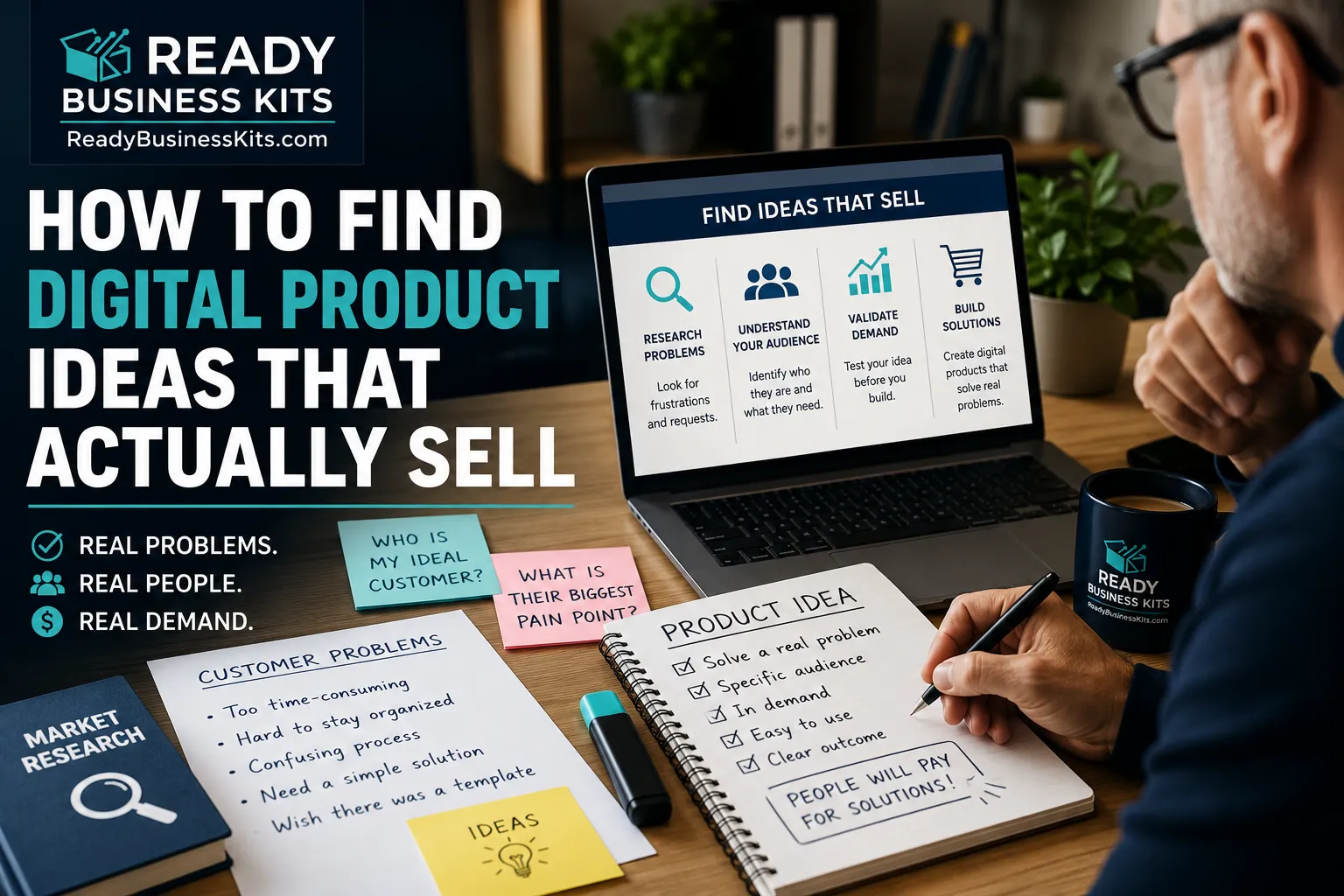
Quick answer: The best digital product ideas usually come from problems people are already trying to solve. Look for repeated questions, frustrating workarounds, products people already buy, underserved groups inside proven markets, and search behavior that shows active demand. Then compare your strongest ideas and validate the winner before investing time in building the full product.
Most people who struggle to sell digital products do not fail because they created something poorly. They fail because they created something buyers were not actively looking for.
They begin with a skill, hobby, or personal interest and ask:
“What can I make?”
Then they spend weeks writing, designing, formatting, and polishing. Only after the product is finished do they discover that the intended audience does not see it as important enough to buy.
The order was backwards.
Successful digital product creators usually begin with a different question:
“What problem are people already trying to solve?”
They look for evidence that people are searching, complaining, improvising solutions, buying related products, or repeatedly asking for help. Only then do they decide what to create.
You do not need a revolutionary invention. You need a useful solution to a specific problem experienced by a recognizable group of buyers.
This guide explains how to uncover those opportunities, evaluate them, and choose a digital product idea that has a realistic chance of selling.
Why Digital Product Ideas Fail Before They Are Built
Digital products are attractive because they can often be created with relatively low overhead. There is no physical inventory to store, no package to ship, and usually little additional production cost when another copy is sold.
However, the low barrier to entry also means buyers have plenty of choices.
A product does not succeed simply because it is attractive, detailed, or professionally formatted. It must solve a problem that buyers care about enough to address.
Three problems repeatedly weaken new digital product ideas.
The Idea Came From the Creator, Not the Customer
The creator chooses a topic because it is personally interesting or easy to create.
That may produce a good product, but personal enthusiasm does not prove customer demand.
A useful idea must connect your knowledge with something the market already wants.
The Audience Was Assumed Rather Than Identified
Descriptions such as “small business owners,” “busy parents,” or “people who want to be organized” are usually too broad.
Different small business owners have different problems. A freelance designer, restaurant owner, consultant, and local contractor may not need the same templates, instructions, or systems.
The more clearly you can identify the buyer, the easier it becomes to understand what that person needs.
The Full Product Was Built Before the Idea Was Tested
Creators frequently spend weeks building a course, guide, planner, bundle, or membership before asking potential buyers whether the problem is important.
By that point, they are emotionally attached to the idea and reluctant to change direction.
A stronger approach is to test the problem, audience, promise, and format before creating the complete product.
Start With Problems, Not Product Formats
A common mistake is beginning with a format:
- “I want to create an ebook.”
- “I want to sell printables.”
- “I want to make a course.”
- “I want to design templates.”
The format should come later.
Start with the problem. Then choose the simplest format capable of solving it.
For example, a customer who needs help writing follow-up emails may not need a two-hour video course. A collection of proven email templates, instructions, and examples may provide a faster and more useful solution.
A person trying to organize a complicated process may need a checklist or spreadsheet rather than an ebook.
Use this sequence:
- Identify the buyer.
- Identify the problem.
- Identify the desired outcome.
- Determine the information or tool needed to reach that outcome.
- Choose the best product format.
This keeps the product centered on the customer rather than the creator’s preferred method of production.
Method 1: Mine Your Own Expensive Lessons
One of the best places to find digital product ideas is your own experience—particularly problems that took considerable time, money, trial and error, or frustration to solve.
These are your expensive lessons.
An expensive lesson does not necessarily involve a large financial loss. The cost may have been:
- Several weeks of research
- Repeated mistakes
- Missed opportunities
- Stress and uncertainty
- Complicated instructions
- Disorganized information
- Paying for services that did not work
- Creating your own system because no suitable solution existed
Once you have solved the problem, your notes, process, checklist, scripts, or templates may be useful to someone who is currently at the beginning of the same journey.
How to Find Your Expensive Lessons
Write down five problems you have solved in the past several years.
For each problem, answer:
- What was I trying to accomplish?
- What made the process difficult?
- What mistakes did I make?
- What finally worked?
- What would have saved me the most time?
- Who else is likely facing the same problem?
- Would that person pay for a faster or simpler solution?
Imagine a freelance bookkeeper who developed a reliable process for collecting overdue invoices. That process might include reminder emails, payment terms, follow-up schedules, and escalation scripts.
Those materials could become a practical collection for other freelancers who dislike chasing clients for payment.
Likewise, a local service provider who created a simple method for requesting customer reviews could package the request messages, response templates, and follow-up schedule for similar businesses.
Your experience becomes commercially useful when it can be transformed into a repeatable shortcut for someone else.
Method 2: Pay Attention to Repeated Questions
Repeated questions are strong idea signals because they show that people are actively seeking guidance.
Look for questions that appear regularly in:
- Reddit communities
- Facebook groups
- LinkedIn groups
- YouTube comments
- Online forums
- Professional associations
- Customer-support discussions
- Comments on industry blogs
- Your own email inbox or direct messages
Reddit allows users to search posts and comments within individual communities, making it possible to examine recurring discussions around a narrow subject.
Search for phrases such as:
- “How do I…”
- “Does anyone have a template for…”
- “What is the easiest way to…”
- “I am struggling with…”
- “I wish there were…”
- “Is there a simple tool for…”
- “Can someone explain…”
- “What do you use to…”
Do not rely on a single comment. Look for repetition across several discussions, dates, or communities.
One isolated complaint may be personal preference. The same complaint appearing repeatedly suggests a broader problem.
Create a Problem-Research Document
Use a spreadsheet or simple document with these columns:
| Source | Exact Question or Complaint | Type of Person | Current Workaround | Desired Outcome |
|---|---|---|---|---|
| “How do I track project revisions?” | Freelance designer | Email and handwritten notes | Keep revisions organized | |
| Facebook group | “Does anyone have a client onboarding checklist?” | Consultant | Recreates steps for every client | Start projects consistently |
| YouTube comment | “Can you provide the spreadsheet?” | Small business owner | Builds one from the tutorial | Use a ready-made tool |
Record the customer’s wording rather than immediately rewriting it into marketing language.
The phrases buyers naturally use can later help you write:
- Product titles
- Sales-page headlines
- Product descriptions
- Search keywords
- Email subject lines
- Frequently asked questions
Method 3: Find Workarounds People Have Already Created
A workaround is something people build or do because the ideal solution is unavailable, difficult to find, too expensive, or too complicated.
Common workarounds include:
- Homemade spreadsheets
- Notes stored in several places
- Repetitive copy-and-paste processes
- Printed checklists
- Email drafts saved for repeated use
- Complicated combinations of free tools
- Instructions gathered from several websites
- Manual calculations
- Personal filing systems
Workarounds matter because they show that the problem is important enough for people to take action.
Someone who says, “That sounds interesting,” may simply be polite.
Someone who has spent three hours building a spreadsheet to solve the problem has demonstrated genuine need.
Ask potential customers:
- How are you handling this now?
- What have you already tried?
- What takes the most time?
- What do you dislike about your current method?
- What happens when the process goes wrong?
- Have you paid for anything to solve it?
- What is still missing?
The best product opportunity may not require inventing a completely new solution. It may involve turning an awkward workaround into a cleaner, faster, easier-to-use system.
Method 4: Study Products That Are Already Selling
Competition is not automatically bad.
When several businesses sell products addressing the same problem, that may indicate that buyers already understand the category and are willing to spend money on it.
The goal is not to copy another seller’s product. It is to study the market and identify opportunities to serve customers better.
Search marketplaces and independent websites for products related to your idea.
Depending on the niche, you might examine:
- Etsy
- Amazon
- Creative Market
- Gumroad
- Udemy
- App marketplaces
- Template marketplaces
- Independent creator websites
- Industry-specific marketplaces
Etsy’s Marketplace Insights tool, for example, uses Etsy search data to show what buyers are looking for and provides information about search frequency and competition for terms available through the tool.
Availability, features, and marketplace data can change, so always verify the tools currently offered by the platform you are researching.
What to Examine
For each competing product, record:
- Target customer
- Problem solved
- Product format
- Price
- Main promise
- What is included
- Number and quality of reviews
- Positive review themes
- Negative review themes
- Questions buyers ask
- Missing features
- Complaints about complexity
- Complaints about instructions
- Requests for additional examples
Reviews are particularly valuable.
Five-star reviews reveal what customers value most.
Three-star reviews often reveal useful gaps because the customer saw value in the product but found something incomplete, confusing, or poorly matched to the situation.
One-star reviews may expose serious problems, although some complaints will be unrelated to product quality.
Look for recurring patterns rather than basing your decision on one review.
Method 5: Find a Specific Angle Inside a Proven Market
You do not need to discover a category that has never existed.
A more realistic approach is to find a specific audience, use case, skill level, or delivery format within a market where demand already exists.
Consider a general product such as a business budget spreadsheet.
Possible specialized versions include:
- Budget spreadsheet for new freelancers
- Cash-flow tracker for seasonal businesses
- Budget system for one-person consulting businesses
- Expense tracker for local service providers
- Irregular-income planner for independent contractors
- Simple business budget for people who dislike spreadsheets
Each version begins with the same broad category but addresses a more defined customer and situation.
You can differentiate an idea through:
Audience
Who is the product specifically for?
Situation
What event, stage, or circumstance creates the need?
Outcome
What measurable result is the customer trying to achieve?
Skill Level
Is the product designed for beginners, experienced users, or people who dislike technical tools?
Format
Would a checklist, workbook, template, calculator, script collection, or short video be more useful than what competitors currently offer?
Speed
Can the customer use the product immediately rather than completing a lengthy program?
Simplicity
Can you remove unnecessary complexity and provide clearer instructions?
A strong positioning statement follows this pattern:
This product helps [specific person] achieve [specific result] without [major frustration or obstacle].
For example:
This email template system helps local service businesses request more customer reviews without writing a new message for every customer.
That is much clearer than:
Email templates for businesses.
Method 6: Use Search Behavior to Discover Demand
Search behavior can reveal whether people are actively looking for information related to a problem.
Use:
- Google search suggestions
- Related searches on Google
- “People also ask” questions
- YouTube search suggestions
- Marketplace search suggestions
- Google Trends
- Keyword-research tools available to you
Google Trends can compare relative search interest across terms, locations, and time periods. Its data is normalized, so it should not be treated as an exact search-volume report.
Google Trends also displays related searches for terms, which can help uncover adjacent needs and more specific wording.
How to Use Search Research Properly
Suppose you are considering a client-onboarding product.
Compare and investigate phrases such as:
- Client onboarding checklist
- Client onboarding template
- Freelance onboarding process
- Consultant welcome packet
- New client questionnaire
- Client intake form
Your goal is not simply to choose the phrase with the highest apparent interest.
You are trying to learn:
- How buyers describe the problem
- Whether interest is stable or temporary
- Which subtopics appear repeatedly
- Whether people want information, a tool, or a complete system
- Which audience appears underserved
Search data is one piece of evidence. Combine it with marketplace activity, customer conversations, recurring questions, and competitor reviews.
Method 7: Talk to Potential Customers
Online research shows what people discuss publicly. Direct conversations reveal how they actually handle the problem.
Speak with five to ten people who resemble your intended buyers.
They may be:
- Former coworkers
- Existing customers
- Professional contacts
- Members of a local business group
- People in an online community
- Friends or relatives who genuinely match the audience
Do not begin by pitching your idea.
Ask about their current behavior.
Useful questions include:
- Walk me through how you currently handle this.
- What is the most difficult part?
- How often does the problem occur?
- What have you tried?
- What did you dislike about those solutions?
- What happens if the problem is not solved?
- How much time does it currently take?
- Have you purchased any related tools or training?
- What would make a solution genuinely useful?
- Would you prefer instructions, templates, examples, automation, or personal guidance?
Avoid asking only:
“Would you buy this?”
People often overstate what they might do in the future.
Current behavior is more reliable than hypothetical enthusiasm.
Build a Digital Product Idea Scorecard
Once you have several possibilities, score each idea before choosing one.
Rate each factor from 1 to 5.
| Factor | Question |
|---|---|
| Problem Strength | Is the problem frustrating, expensive, frequent, or urgent? |
| Audience Clarity | Can you clearly identify the buyer? |
| Evidence of Demand | Are people searching, asking, buying, or creating workarounds? |
| Purchasing History | Do buyers already spend money on related solutions? |
| Creator Fit | Do you have useful knowledge or experience? |
| Product Simplicity | Can you create a useful first version without months of work? |
| Differentiation | Can you serve a specific audience or need better? |
| Marketing Access | Can you realistically reach these buyers? |
| Expansion Potential | Could the idea lead to bundles, upgrades, or related products? |
Multiply nothing and do not pretend the score is scientific.
Its purpose is to force a disciplined comparison.
An idea that scores poorly on audience clarity, evidence, and marketing access should not become your first product simply because it sounds exciting.
Validate the Idea Before Creating the Full Product
Once you have narrowed your choices to one promising idea, follow our complete guide on How to Validate a Digital Product Idea Before You Build It to test demand before committing to full production.
Research helps you select a promising idea. Validation tests whether people will take a meaningful action.
Use the smallest test that can provide useful evidence.
Create a Simple Offer Page
Build a basic page containing:
- The customer’s problem
- The promised outcome
- Who the product is for
- What the product will include
- The expected price
- A waitlist, interest form, or preorder option
Prelaunch pages are commonly used to explain an upcoming offer and collect interest before launch. Kickstarter, for example, provides prelaunch pages that allow prospective backers to request launch notifications.
Do not rely on a universal conversion-rate benchmark. Results depend heavily on the traffic source, audience familiarity, price, offer, and strength of the problem.
Instead, compare responses across different messages or versions of the offer.
Offer a Paid Pilot or Presale
A paid commitment is stronger evidence than a compliment, like, or survey response.
You can offer:
- A discounted early-buyer version
- A paid pilot
- A preorder with a clearly stated delivery date
- A small first edition
- A live workshop that later becomes a recorded product
Be completely clear about what exists, what is still being created, when it will be delivered, and what happens if you cannot deliver it.
Create the Minimum Useful Version
Do not build every possible feature.
Create the smallest version that solves the core problem.
For example:
- One spreadsheet instead of a 30-template bundle
- Ten essential scripts instead of 100
- One workshop instead of a complete course
- A short workbook instead of a large ebook
- One process checklist instead of an entire business system
Then observe what customers actually do.
Do they use it?
Do they complete it?
Do they ask questions?
Do they request additional examples?
Do they recommend it?
Do they ask whether you offer a more complete version?
Behavior provides better guidance than praise.
Strong and Weak Demand Signals
Stronger Signals
- Several unrelated people describe the same problem.
- People have created their own workaround.
- Customers are already paying for related products.
- Competing products have consistent, detailed reviews.
- Potential buyers ask when the solution will be available.
- People join a targeted waitlist.
- Buyers pay for a pilot, presale, or minimum version.
- Early users return, use the product, and request more.
Weaker Signals
- Friends say the idea sounds good.
- Social-media posts receive likes but no meaningful action.
- People express interest in the general topic but not the specific problem.
- Survey respondents say they “might” purchase someday.
- The idea is based entirely on a temporary trend.
- The intended audience is difficult to identify or reach.
- People want the solution only if it is free.
- Potential buyers like the product but do not consider the problem important.
No single signal guarantees success. Look for several forms of evidence pointing in the same direction.
Common Mistakes When Choosing a Product Idea
Choosing a Topic Instead of a Problem
“Marketing,” “productivity,” and “personal finance” are topics.
“Creating a month of social-media posts in one afternoon” is a problem and outcome.
Targeting Everyone
A product for everyone is difficult to explain and difficult to promote.
Choose one customer first. You can expand later.
Confusing Interest With Buying Intent
Likes, votes, and compliments require little commitment.
Email signups, interviews, trial use, and purchases require more effort and therefore provide stronger evidence.
Copying a Competitor
Research the market, but create your own content, structure, examples, branding, and solution.
Your advantage should come from understanding the customer better—not duplicating someone else’s work.
Building Too Much
A large product is not automatically more valuable.
Customers usually want the fastest reliable path to an outcome, not the greatest number of pages or files.
Relying on One Research Source
Marketplace reviews alone are not enough. Search trends alone are not enough. One customer interview is not enough.
Combine several sources.
Chasing Trends Without Checking Durability
A trend can create a temporary opportunity, but demand may disappear quickly.
Ask whether the underlying problem will still exist after the current attention fades.
Ignoring Distribution
An idea may be good but impractical if you have no realistic way to reach the customer.
Before choosing it, identify at least one dependable channel:
- Search traffic
- Email marketing
- Marketplace traffic
- Professional communities
- Social-media content
- Existing customers
- Partnerships
- Local business networks
A product idea and a customer-access plan should be developed together.
A Seven-Day Product-Idea Research Plan
Day 1: List Your Expensive Lessons
Write down problems you have personally solved and shortcuts you could teach.
Day 2: Research Customer Questions
Study two or three communities where potential buyers gather. Record recurring problems in their own words.
Day 3: Study Existing Products
Find competing or related products. Record pricing, positioning, formats, reviews, complaints, and missing features.
Day 4: Examine Search Behavior
Use search suggestions, related searches, marketplace tools, and Google Trends to understand how people describe the need.
Day 5: Conduct Customer Conversations
Speak with at least three people who match the intended audience. Focus on present behavior and current frustrations.
Day 6: Score Your Best Ideas
Use the product-idea scorecard to compare your strongest possibilities.
Choose one specific audience, one problem, and one promised outcome.
Day 7: Create a Validation Test
Publish a simple offer page, invite people to a waitlist, present a paid pilot, or sell a minimum version.
Do not spend the seventh day building the complete product.
Spend it gathering evidence that the product deserves to be built.
Final Product-Idea Checklist
Before committing to an idea, confirm that you can answer yes to most of these questions:
- Can I describe the buyer in one sentence?
- Can I describe the problem in one sentence?
- Does the problem cost the buyer time, money, effort, or peace of mind?
- Have several people independently mentioned the problem?
- Are people searching for related help?
- Have people created workarounds?
- Are buyers paying for related solutions?
- Can I identify weaknesses in current options?
- Do I have a clear and ethical way to differentiate my product?
- Can I reach the audience?
- Can I create a minimum useful version quickly?
- Can I test the idea before building the complete product?
- Could the first product lead naturally to related offers or bundles?
If you cannot answer these questions clearly, continue researching.
That is not failure. It is the process protecting you from spending weeks on an unproven product.
Ready to Test Your Best Product Idea?
Finding a promising digital product idea is only the beginning. The next step is determining whether real buyers will respond before you invest significant time creating it.
The 7-Day Offer Validation & Launch System gives you a structured process for researching demand, organizing your assumptions, testing your offer, and deciding whether to move forward.
See the 7-Day Offer Validation & Launch System →
Conclusion
Digital product ideas that sell rarely arrive as sudden flashes of inspiration.
They are usually discovered by observing what people repeatedly ask, complain about, purchase, improvise, and struggle to complete.
Start with your own expensive lessons. Study customer conversations. Examine competing products and their reviews. Look at search behavior. Speak directly with potential buyers. Then test the smallest practical version of the idea before committing to full production.
Do not ask only:
“Can I create this?”
Ask:
“Who needs this, what problem does it solve, and what evidence shows that the problem matters?”
When those answers are clear, your idea is no longer based entirely on hope. It is based on observable demand—and that gives you a far stronger foundation for building a digital product people will actually buy.
Ready to turn your strongest idea into a real product? The Product Creation Planning Kit gives you a structured way to define your audience, organize the product, plan what to include, and map out the creation process before you start building