
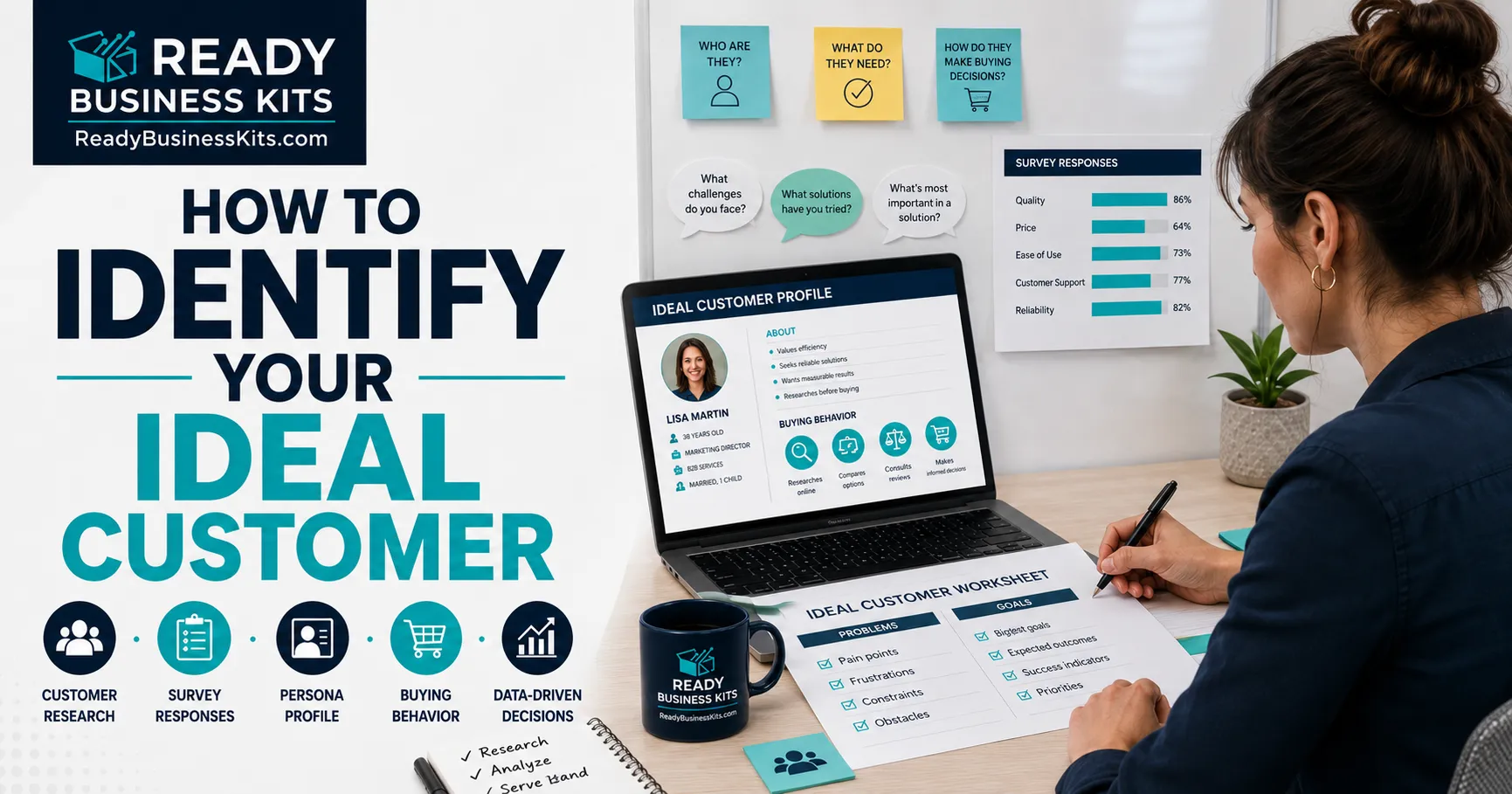
Quick Answer: How Do You Identify Your Ideal Customer?
Your ideal customer is the person most likely to experience the problem your product solves, actively want a solution, value the outcome you provide, and be willing to pay for it.
Start by identifying one specific customer and researching their recurring problems, desired outcomes, previous solutions, buying triggers, objections, and the language they use to describe the problem.
Use real evidence from customer conversations, reviews, search behavior, communities, surveys, and competing products rather than creating an imaginary buyer persona based on assumptions.
Creating a digital product before you know who it is for is one of the fastest ways to waste time, money, and effort.
Your customer cannot simply be “anyone who wants to be more productive,” “small business owners,” or “people interested in making money online.” Those descriptions are too broad to guide your product, pricing, sales copy, or marketing.
You need to identify a more specific person:
- Someone experiencing a recognizable problem
- Someone actively looking for a practical solution
- Someone who can benefit from the type of product you plan to sell
- Someone willing and able to pay for the outcome you provide
The goal is not to exclude everyone else permanently. The goal is to identify the customer most likely to understand the value of your product and purchase it first.
This guide explains how to identify your ideal customer using real evidence rather than assumptions. You will learn how to uncover customer problems, goals, frustrations, buying triggers, objections, online behavior, and the language customers use when describing what they need.
What Is an Ideal Customer?
An ideal customer is the person most likely to:
- Experience the problem your product solves
- Recognize that the problem needs attention
- Want the outcome your product promises
- Trust your method of delivering that outcome
- Pay a price that makes the product profitable
This is more useful than identifying everyone who could theoretically use your product.
For example, a general bookkeeping spreadsheet could be used by freelancers, consultants, online sellers, local service businesses, nonprofit organizations, and hobby businesses. However, each group may have different needs, terminology, buying motivations, and objections.
A freelancer might want a simple way to track irregular income and prepare for quarterly taxes.
An Etsy seller may care more about product costs, transaction fees, advertising expenses, and profit per item.
A consultant may want to track client retainers, project expenses, and overdue invoices.
The spreadsheet may have broad potential, but your initial marketing will usually perform better when it speaks directly to one primary customer and one recognizable problem.
That specificity affects everything from the product title to the examples included inside the product.
Ideal Customer vs. Target Audience vs. Buyer Persona
These terms are often used interchangeably, but they serve different purposes.
Target Audience
Your target audience is the broader group of people your business may serve.
Examples include:
- Freelance service providers
- New digital product creators
- Local business owners
- Coaches and consultants
- Etsy sellers
- First-time online entrepreneurs
A target audience gives you a general market direction, but it is usually too broad to guide detailed marketing decisions.
Ideal Customer
Your ideal customer is the most suitable buyer within that broader audience.
For example:
A freelance graphic designer who has several recurring clients but struggles to manage proposals, project deadlines, invoices, and follow-up tasks.
That description is more actionable than simply saying “freelancers.”
Buyer Persona
A buyer persona is a practical, research-based profile that organizes what you have learned about your ideal customer.
It may include:
- Their current situation
- Their most urgent problem
- Their desired outcome
- What they have already tried
- Why previous solutions disappointed them
- What might trigger them to purchase
- What objections may prevent them from purchasing
- Where they look for information
- The words they use to describe the problem
A persona should summarize patterns discovered through research. It should not be a fictional biography filled with details that have no effect on the buying decision.
Knowing that your imaginary customer drives a blue SUV, drinks vanilla coffee, and has a golden retriever will not help you create a better invoice template or write a stronger sales page.
Knowing that your customer delays sending invoices because the process feels disorganized and uncomfortable could affect both.
Why You Should Identify Your Customer Before Building
Customer research should influence the product before you spend weeks creating it.
The U.S. Small Business Administration recommends using market research to evaluate demand, market size, customer characteristics, pricing, market saturation, and where potential customers can be reached. This information helps entrepreneurs reduce risk and improve a business idea before making a larger investment.
When you understand your ideal customer, you can make better decisions in several important areas.
Product Features
You can build the features customers actually need instead of adding features because they seem impressive.
Suppose you are creating a social media content planner. Your research may reveal that customers are not struggling to find places to write ideas. They are struggling to turn one idea into multiple posts and maintain a consistent schedule.
That discovery could lead you to include:
- A content-repurposing worksheet
- Weekly posting prompts
- Caption templates
- A simple approval workflow
- A reusable monthly calendar
The product becomes more valuable because its features reflect a real workflow problem.
Product Format
Customer research can help you decide whether the product should be:
- A printable PDF
- An editable spreadsheet
- A Canva template
- A Notion workspace
- A video course
- A checklist
- A workbook
- A bundle containing several formats
A detailed course may be unnecessary when customers want a tool they can use immediately. A one-page checklist may be inadequate when the customer needs instruction, examples, and guided implementation.
The correct format depends on how the customer prefers to solve the problem.
Pricing
Knowing the customer’s situation helps you evaluate the value of the outcome, the urgency of the problem, and the alternatives already available.
You should not choose a price only by looking at the number of pages or files included.
A five-page template that helps a consultant send a professional proposal and win a $2,000 project may provide more practical value than a 100-page ebook that the customer never finishes.
Customer research does not automatically reveal the perfect price. It gives you better information for testing a reasonable price.
Messaging
Your sales copy becomes stronger when it reflects the customer’s actual problem.
Compare these two headlines:
Professional Client Management Template Bundle
and:
Stop Losing Track of Client Deadlines, Invoices, and Follow-Ups
The first describes the product category.
The second describes a situation the customer may already recognize.
Effective messaging connects the product to a specific problem, desired result, or moment of frustration.
Marketing Channels
Customer research also helps you decide where to promote the product.
A product for local contractors may perform better through Google Search, industry Facebook groups, YouTube tutorials, or local business partnerships.
A product for freelance designers may be easier to promote through LinkedIn, Instagram, design communities, newsletters, or freelance forums.
You do not need to market everywhere. You need to show up where your most likely buyers already search, learn, compare options, and ask questions.
Start With a Customer Hypothesis
You do not need to know everything about your customer before beginning your research.
Start with a hypothesis—a statement you intend to investigate rather than assume is true.
Use this format:
I believe this product helps [specific type of person] solve [specific recurring problem] so they can achieve [desired outcome].
For example:
I believe a client onboarding kit helps new freelance service providers organize contracts, questionnaires, payments, and project expectations so they can appear more professional and begin projects with fewer misunderstandings.
This statement gives your research a starting point.
You can now investigate:
- Whether new freelancers consistently experience this problem
- How they currently manage onboarding
- Which parts of the process cause the most frustration
- What tools or templates they have already tried
- What they would expect an onboarding kit to include
- Whether the problem feels urgent enough to justify a purchase
Your original hypothesis may be correct, partially correct, or completely wrong. That is useful information.
The purpose of customer research is not to prove your idea is brilliant. It is to discover what is true before you commit more time and money.
Demographics and Psychographics
A useful customer profile combines demographics with psychographics.
Demographics: Who They Are
Demographic information may include:
- Age range
- Location
- Income range
- Education
- Occupation
- Industry
- Business size
- Family or household situation
- Career or business stage
Demographics can help you estimate market size, narrow your positioning, and select appropriate marketing channels. The SBA includes demographics among the important information businesses can use when assessing their potential market.
However, demographics alone do not explain why someone purchases.
Two customers can be the same age, work in the same industry, and earn similar incomes while having completely different reasons for buying the same product.
Psychographics: Why They Buy
Psychographic information focuses on the customer’s motivations and behavior, including:
- Goals and aspirations
- Priorities
- Fears
- Frustrations
- Beliefs
- Habits
- Buying preferences
- Risk tolerance
- Definition of success
- Attitude toward time, money, and convenience
Imagine two 40-year-old consultants purchasing the same sales-page template.
The first consultant may be overwhelmed and wants to finish a sales page quickly.
The second may already have a sales page but believes it looks unprofessional and weakens trust.
The demographics are similar. The motivation is different.
The first customer may respond to:
Create your sales page in one focused afternoon.
The second may respond to:
Present your offer with clearer messaging and a more professional structure.
Demographics help you locate a possible customer. Psychographics help you understand what that customer needs to hear.
The Five Areas You Need to Understand
Your research should uncover five connected parts of the customer’s experience.
1. Problems
What is currently difficult, broken, slow, expensive, confusing, or missing?
Avoid vague descriptions.
Instead of:
They struggle with marketing.
Look for something more specific:
They do not know what to post consistently, so their social media accounts remain inactive for weeks.
A specific problem gives you something concrete to solve.
2. Goals
What result is the customer trying to achieve?
The immediate goal may be:
- Launching a first product
- Organizing client work
- Building an email list
- Creating a professional sales page
- Saving time on repetitive tasks
- Increasing conversion rates
- Replacing inconsistent income
Look beyond the surface result when possible.
A customer may say they want a proposal template, but the deeper goal may be to look credible enough to charge higher prices and win better clients.
3. Frustrations
What irritates the customer about the current situation or available solutions?
Common frustrations may include:
- Tools that are too complicated
- Templates that require extensive editing
- Courses that provide information without implementation tools
- Products created for advanced users rather than beginners
- Instructions that assume technical knowledge
- Bundles filled with files the customer does not need
- Products that look attractive but do not improve the workflow
Frustrations often reveal an opportunity to improve the customer experience.
4. Fears
What does the customer worry may happen if the problem continues?
They may fear:
- Wasting more money
- Choosing the wrong tool
- Looking unprofessional
- Missing a deadline
- Disappointing a client
- Falling behind competitors
- Spending weeks creating something nobody buys
- Becoming trapped in another complicated system
Fear should not be exaggerated or manipulated. Understanding it helps you address legitimate concerns clearly and responsibly.
5. Motivations
What makes the customer willing to take action?
Possible motivations include:
- Saving time
- Reducing stress
- Increasing income
- Improving organization
- Looking more professional
- Gaining confidence
- Avoiding a costly mistake
- Reaching a deadline
- Taking advantage of a new opportunity
A customer can have a problem for months without purchasing anything. Motivation explains why solving it becomes important now.
Where Your Ideal Customers Spend Time Online
You cannot understand customers by studying only your own product idea. You need to observe where potential buyers already ask questions, compare solutions, describe frustrations, and recommend products.
Your audience may gather in:
- Google search results
- Reddit communities
- Facebook groups
- YouTube comment sections
- LinkedIn discussions
- Amazon, Etsy, and software reviews
- Industry forums
- Professional associations
- Discord communities
- Email newsletters
- Podcasts and creator communities
Do not assume your audience uses every platform.
A business consultant may be active on LinkedIn and subscribe to industry newsletters but rarely use TikTok. A new Etsy seller may spend more time in Facebook groups, YouTube tutorials, and marketplace forums.
Your goal is to identify the two or three sources that provide the clearest evidence of customer problems and buying behavior.
How to Research Your Ideal Customer for Free
You do not need expensive research software to begin. Public conversations, search behavior, product reviews, and direct questions can provide useful evidence.
Use Google Search to Discover Customer Questions
Begin with a broad phrase related to your product and observe the suggested searches that appear.
For example, if you are considering a client onboarding kit, try searches such as:
- How to onboard freelance clients
- Client onboarding checklist
- Client onboarding process for beginners
- What to include in a client welcome packet
- How to collect information from a new client
- Client onboarding template
Look for recurring words and questions.
You can also add modifiers such as:
- Best
- Beginner
- Template
- Checklist
- Alternative
- Review
- Worth it
- Problems
- For freelancers
- For small businesses
Search results do not prove that a product will sell, but they can help you understand how people describe the problem and what information they seek.
Google Trends can also help you compare interest between terms, examine changes over time, and review geographic interest. Google explains that Trends data reflects relative search interest rather than exact search volume, so it should be used as one research signal rather than proof of market size.
Study Reddit Discussions
Reddit can help you find candid discussions about problems, purchases, tools, and disappointing experiences.
Search Reddit directly or use Google:
site:reddit.com [your topic]
Useful searches might include:
- site:reddit.com freelance client onboarding problems
- site:reddit.com best invoice template small business
- site:reddit.com digital product launch mistakes
- site:reddit.com content planner worth it
Read the original post and the comments.
Look for:
- Questions that appear repeatedly
- Solutions people recommend without being prompted
- Products people regret purchasing
- Tasks people continue doing manually
- Features people wish existing products included
- Language customers use to describe frustration
- Reasons people reject recommended solutions
Do not treat one popular comment as conclusive evidence. Look for patterns across several unrelated discussions.
Search Facebook Groups
Join groups built around the customer’s profession, business model, goal, or problem.
Use the group search function to find terms related to your proposed product.
For example, inside a group for freelance service providers, search:
- Onboarding
- Proposal
- Contract
- Invoice
- Client questionnaire
- Scope creep
- Late payment
- Project management
Read older posts before asking your own question. You may discover that the same issue has already been discussed many times.
Do not enter a community and immediately promote your product. Observe the group rules, contribute appropriately, and use the discussion to understand the audience rather than harvest comments for aggressive marketing.
Read YouTube Comments
Find popular tutorials, demonstrations, comparisons, and product reviews in your niche.
Pay attention to comments that begin with phrases such as:
- “I still don’t understand…”
- “What do I do if…”
- “I wish this included…”
- “I tried this, but…”
- “Is there a simpler way…”
- “Does this work for…”
- “Can someone recommend…”
These phrases often reveal gaps between the information provided and the help viewers still need.
A video may teach people how to build a sales page, while the comments reveal that viewers are actually struggling with writing the headline, organizing the offer, or deciding what proof to include.
That distinction can influence the product you create.
Analyze Product Reviews
Read reviews for products that solve the same or a related problem.
Potential sources include:
- Amazon
- Etsy
- App marketplaces
- Software directories
- Course platforms
- Trustpilot
- Competitor websites
- Industry marketplaces
Read positive and negative reviews.
Positive reviews reveal what customers value.
Negative reviews reveal what creates disappointment.
Middle-range reviews can be especially useful because reviewers often explain both what worked and what remained incomplete.
Record comments about:
- Ease of use
- Instructions
- Product format
- Customization
- Missing features
- Customer support
- Time required
- Technical difficulty
- Value for the price
- Quality of examples
- Suitability for beginners
Use reviews to identify patterns, not to copy a competitor’s wording, content, layout, or product.
If you want to expand this research beyond reviews, our guide on how to research competitors before launching explains how to compare competing offers, positioning, pricing, customer feedback, and market gaps systematically.
If you later publish customer reviews or testimonials in your own marketing, they must be truthful and not misleading. The Federal Trade Commission also prohibits deceptive practices involving fake reviews, undisclosed incentives, and manipulation designed to distort what consumers believe about a product.
Conduct Short Customer Interviews
Direct conversations can reveal information that people do not post publicly.
You do not need to conduct a formal hour-long interview. A focused 15- to 20-minute conversation can be useful when the questions are specific.
Ask about the customer’s actual behavior:
- Tell me about the last time this problem occurred.
- What did you do to solve it?
- What was the most frustrating part?
- Which tools or products did you try?
- What did those solutions fail to provide?
- How much time does the problem currently cost you?
- What would a useful solution need to accomplish?
- What would make you hesitate before purchasing it?
Avoid leading questions such as:
Would you buy my amazing new client onboarding bundle for $37?
That question encourages politeness and speculation.
A better question is:
Have you purchased anything to solve this problem before? What influenced that decision?
Past behavior is generally more useful than a hypothetical promise.
Send a Short Survey
A survey can help you compare responses from several people, especially when you already have:
- An email list
- Social media followers
- Past customers
- Website visitors
- Members of a relevant community
- Professional contacts within the target market
Keep the survey short.
Useful questions include:
- What is the most difficult part of completing this task?
- What have you already tried?
- Why did that solution fall short?
- What would make the process easier?
- What would you need to see before paying for a solution?
Open-ended questions produce richer language. Multiple-choice questions make responses easier to compare.
A practical survey can combine both.
For example:
What is your biggest client-onboarding challenge?
- Collecting client information
- Sending agreements
- Receiving payment
- Setting expectations
- Organizing project files
- Other: _______
Follow it with:
Please describe what makes this difficult.
Create a Customer Research File
Do not rely on memory. Create a simple spreadsheet or document where you record what you find.
Use columns such as:
| Source | Exact Customer Language | Problem | Desired Outcome | Previous Solution | Frustration | Trigger | Objection |
|---|
Record direct language accurately and include the source so you can review the context later.
You are looking for repetition across different people and platforms.
One complaint may be an individual preference.
The same complaint appearing in reviews, community discussions, interviews, and surveys is a stronger signal.
The SBA recommends combining direct research—such as surveys, questionnaires, focus groups, and interviews—with existing market information when evaluating potential customers and demand.
Identify Buying Triggers
A problem alone does not guarantee an immediate purchase.
A buying trigger is an event or circumstance that causes the customer to begin actively searching for a solution.
Common triggers include:
- A new client or project
- An approaching launch date
- A missed deadline
- A costly mistake
- A negative customer experience
- A sudden increase in workload
- A new business or side hustle
- A change in income
- A seasonal deadline
- A recommendation from a trusted person
- Frustration after another solution fails
For example, a freelancer may tolerate an informal onboarding process while managing one client. After signing three clients in the same week, the disorganization becomes urgent.
That change creates a buying moment.
Your marketing should connect the product to a legitimate situation in which the customer recognizes the need for help.
Identify the Customer’s Main Objections
Even interested customers may hesitate.
Common objections include:
“I Can Make This Myself”
The customer may not understand how much time the product saves.
Show what is already completed, organized, editable, or ready to implement.
“I Have Purchased Similar Products Before”
The customer may have been disappointed by vague instructions, poor design, limited customization, or unnecessary files.
Explain specifically how your product is different without attacking competitors.
“This May Not Work for My Situation”
The customer may not see themselves represented in the examples or description.
Clarify who the product is for, what situations it covers, and any important limitations.
“It Costs Too Much”
The customer may not understand the relationship between the price and the outcome.
Explain the practical value, included components, time saved, and problems avoided. Do not rely on artificial discounts or exaggerated savings.
“I Will Buy It Later”
The problem may not feel urgent.
You can connect the product to genuine deadlines, seasonal events, business stages, or immediate implementation needs. Do not invent false scarcity.
Your customer research should help you identify which objections appear repeatedly. Those objections should be addressed in your:
- Product description
- Sales page
- FAQ
- Email sequence
- Guarantee or refund terms
- Product preview
- Testimonials
- Checkout messaging
Build a Practical Customer Persona
Once you have collected enough evidence, organize the recurring patterns into a simple customer persona.
Your persona should contain information that affects your product or marketing decisions—not decorative details that add no business value.
Include:
- Current situation: Their profession, business stage, or relevant life situation
- Primary problem: The specific recurring problem they want solved
- Desired outcome: What they want to accomplish
- Previous attempts: Products, tools, or methods they have already tried
- Main frustration: Why those attempts were incomplete or disappointing
- Buying trigger: What causes them to seek a solution now
- Primary objection: What may stop them from purchasing
- Preferred format: How they want the solution delivered
- Research sources: Where they search for answers and recommendations
- Customer language: Exact phrases repeatedly found during research
Here is a practical example:
Ideal customer: A new freelance service provider managing three to five clients without a consistent onboarding system. They are worried about appearing unprofessional, forgetting important details, and allowing projects to begin without clear expectations. They have tried using separate documents and free templates but find the process disorganized. A new client or growing workload is likely to trigger a purchase. Their main objection is whether a paid template bundle will save enough time to justify the price.
That profile can influence:
- The product name
- The files included
- The examples used
- The sales-page headline
- The price
- The FAQ
- The marketing channels
- The lead magnet
- The email follow-up sequence
Use Research to Improve Your Product and Marketing
Customer research should lead to decisions.
Improve the Product
Add features that solve recurring problems. Remove features customers do not value or understand.
Improve the Positioning
Explain why your product is appropriate for the customer’s specific situation.
Improve the Messaging
Use the language customers use naturally instead of technical or vague product descriptions.
Improve the Price
Consider the value of the result, the urgency of the problem, comparable alternatives, and the customer’s ability to pay.
Improve the Sales Page
Address the customer’s goals, frustrations, previous disappointments, buying triggers, and objections.
Improve the Marketing Plan
Focus on the platforms and content formats your customers already use rather than trying to promote the product everywhere.
The SBA recommends evaluating demand, customer characteristics, market saturation, pricing, and where customers can be reached before committing significant resources to a business idea.
Common Ideal-Customer Research Mistakes
Targeting Everyone
A product designed for “all entrepreneurs” usually produces generic features and weak messaging.
Choose one primary customer first. You can expand later.
Confusing Possible Users With Likely Buyers
Many people could use your product. Your ideal customer is the person most likely to recognize the problem, value the solution, and purchase it.
Depending Only on Demographics
Age, occupation, and income provide context, but they do not explain why someone buys.
Asking Leading Questions
Questions such as “Would you buy this?” often produce polite but unreliable answers.
Ask about actual experiences, previous purchases, current problems, and recent behavior.
Treating One Comment as Proof
One enthusiastic post or negative review does not establish a market pattern.
Look for repetition across several independent sources.
Inventing Persona Details
Do not add unsupported details merely to make the profile appear complete.
Copying Customer Reviews
Reviews can help you identify patterns, but you should not copy a reviewer’s content into your marketing without permission.
Reviews and testimonials used in your own promotion must also be truthful and not misleading. The FTC’s Consumer Reviews and Testimonials Rule addresses practices including fake reviews, certain paid review arrangements, review suppression, and misrepresenting company-controlled review sites as independent.
Assuming Every Complaint Represents Demand
A gap in an existing product is not automatically a profitable opportunity.
Confirm that:
- The complaint appears repeatedly
- Customers care enough to seek alternatives
- The improvement produces a meaningful result
- Buyers are willing to pay for the solution
- You can deliver it profitably
Step-by-Step Customer Research Process
Once you have identified the customer and adjusted the offer around what you learned, use our guide on how to validate a digital product idea to test whether that customer will take meaningful action before you invest heavily in building the full product.
- Write your starting customer hypothesis.
- Identify three to five places where that customer discusses the problem.
- Collect customer questions, complaints, goals, and exact phrases.
- Study competing and related product reviews.
- Conduct several short customer conversations when possible.
- Use a short survey to test recurring patterns.
- Organize findings into problems, goals, frustrations, fears, and motivations.
- Identify the most common buying trigger.
- List the customer’s top objections.
- Create a research-based persona.
- Adjust your product, price, positioning, and marketing.
- Validate the revised offer before completing the product.
Customer Persona Worksheet
- Primary customer:
- Current situation or business stage:
- Most urgent recurring problem:
- Problem described in their own words:
- Desired result:
- What they have already tried:
- Why previous solutions fell short:
- Biggest frustration:
- Biggest concern or fear:
- Most likely buying trigger:
- Top purchasing objection:
- Preferred product format:
- Where they search for help:
- What would make them trust the product:
- Exact customer phrases worth preserving:
Final Customer Research Checklist
Before building or launching your product, confirm that:
- You have identified one primary customer
- You understand a specific recurring problem
- You know the outcome the customer wants
- You have studied real discussions and reviews
- You have collected customer language
- You know what customers have already tried
- You understand why existing solutions disappoint them
- You have identified a buying trigger
- You know the top objections
- Your product features reflect customer evidence
- Your messaging describes a recognizable problem
- Your pricing reflects the value of the outcome
- You have validated the main assumptions
Conclusion
Identifying your ideal customer is not about creating an imaginary person. It is about collecting enough evidence to understand who is experiencing the problem, what they want instead, what they have already tried, and what would make them trust a new solution.
Start with a hypothesis. Study real conversations. Read reviews. Ask practical questions. Record recurring patterns. Then use what you discover to shape the product before you invest heavily in creating it.
The clearer you become about your ideal customer, the easier it becomes to create a product with a genuine reason to exist—and explain its value to the people most likely to buy it.
Frequently Asked Questions
How Long Should Ideal-Customer Research Take?
A focused initial research period can uncover useful patterns, but there is no universal number of days or conversations that guarantees accuracy.
Continue until recurring problems, goals, language, triggers, and objections become clear across several independent sources.
Do I Need an Existing Audience?
No. You can begin with public reviews, search results, community discussions, YouTube comments, professional forums, and competitor research.
An email list or existing customers can provide additional direct feedback later.
How Specific Should My Ideal Customer Be?
Specific enough that you can clearly describe their situation, problem, desired outcome, buying trigger, and objections.
Avoid narrowing the audience using details that do not affect the product or purchasing decision.
Can One Product Serve Several Customer Types?
Yes, but begin with one primary customer.
Additional segments can be addressed through separate landing pages, examples, bundles, or marketing campaigns after the original positioning has been validated.
What if My Research Contradicts My Product Idea?
Treat that as valuable information.
It is less expensive to revise, reposition, or abandon an idea during research than after completing and launching the product.
Turn Your Customer Research Into a Product Plan
Once you know who the product is for and what problem they need solved, the next step is turning that research into a clear product structure.
The Product Creation Planning Kit gives you a structured way to define the audience, clarify the problem and desired outcome, organize what the product should include, and map the creation process before you start building.
Ready to turn your customer research into a focused product plan? The Product Creation Planning Kit gives you a structured way to define your audience, clarify the problem your product will solve, organize what to include, and map out the creation process before you start building.