
Most digital products do not fail because they are badly designed, poorly written, or technically difficult to use. They fail because the creator chose a niche based on excitement rather than evidence.
Someone sees another seller succeeding with planners, templates, online courses, or printable worksheets and assumes the same type of product will work for them. They spend weeks building it, create a sales page, publish a few social media posts—and then hear nothing.
The problem is usually not the product format. It is the lack of a clearly defined audience with a problem they are already motivated to solve.
Choosing a profitable digital product niche is not about discovering a secret market with no competition. It is about finding:
- A specific group of people.
- A recurring or urgent problem.
- Evidence that people actively seek solutions.
- Proof that buyers already spend money in the market.
- An opportunity to deliver a simpler, faster, clearer, or more specialized solution.
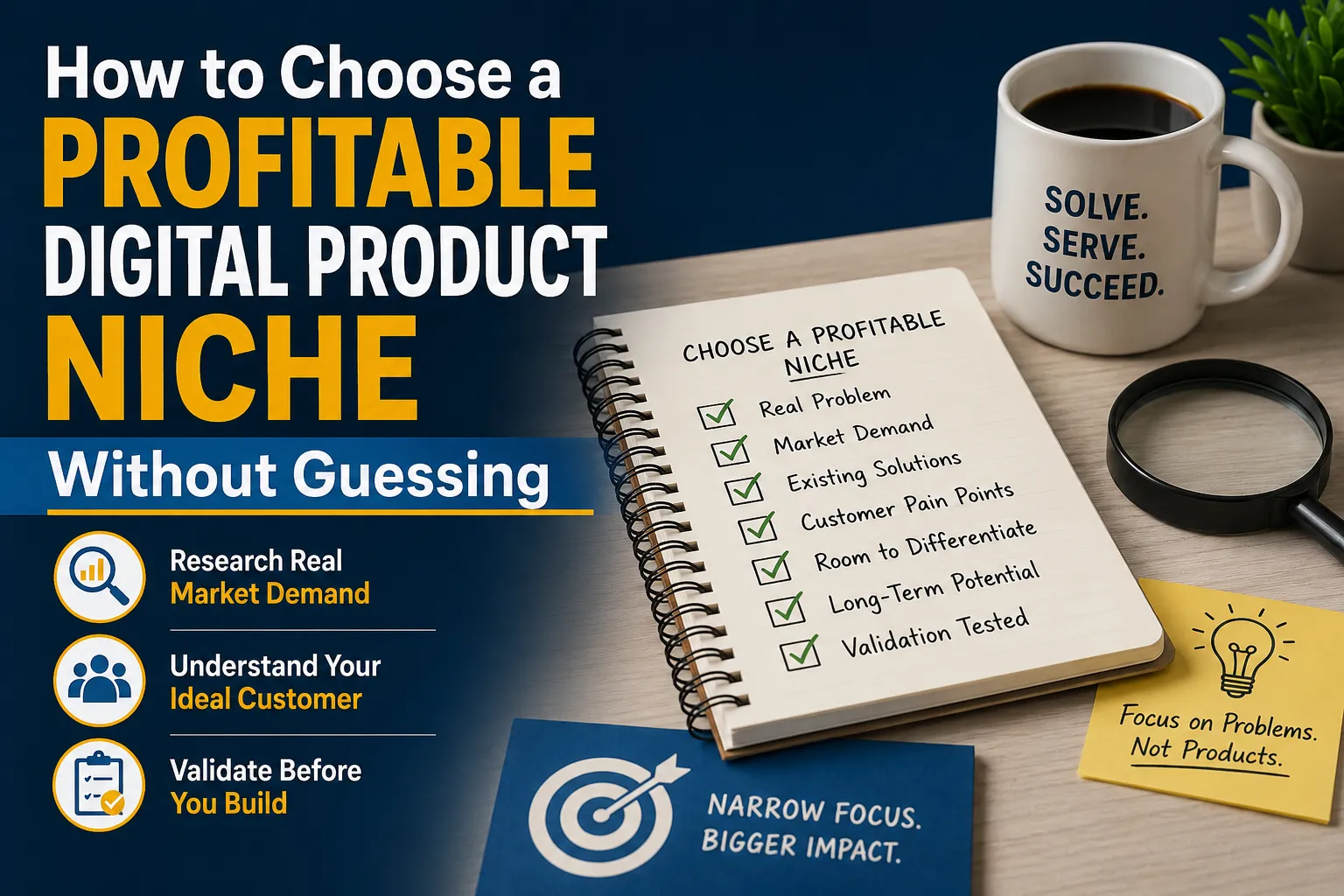
This guide will show you how to evaluate those factors step by step so you can choose a niche based on evidence rather than guesswork.
Quick Answer: How Do You Choose a Profitable Digital Product Niche?
Choose a niche where a specific group of people has a recurring or urgent problem, actively looks for solutions, and already spends money to solve it.
Then look for an opportunity to provide a solution that is clearer, faster, easier to use, or more specialized than the alternatives already available.
Before building the full product, confirm the niche with search activity, marketplace demand, competitor research, customer feedback, and a small real-world validation test.
Why Your Niche Decision Matters So Much
Your niche influences nearly every part of your digital product business, including:
- What products you create.
- How easily you can reach potential customers.
- What customers are willing to pay.
- How much competition you face.
- What content you publish.
- Whether customers return for additional products.
- How long it takes to make your first sales.
A polished product in a weak market can struggle for months. A straightforward product that solves an urgent problem for the right audience can begin attracting attention much faster.
That is why niche research should happen before product development.
It may feel as though you are delaying the “real work,” but research is part of the real work. Every hour you spend confirming demand can save you many hours building and promoting something that people do not want.
Before choosing a niche, it helps to understand the larger business model. If you are still deciding whether this is the right direction for you, begin with our guide on how to start a digital product business. It explains how digital products are created, sold, delivered, and expanded into a sustainable online business.
Step 1: Start With Problems, Not Product Formats
Many beginners begin by asking:
- Should I create an ebook?
- Should I sell Canva templates?
- Should I make a course?
- Should I design printable planners?
- Should I sell spreadsheets?
These questions start at the wrong end of the process.
A template, ebook, course, checklist, or spreadsheet is only a delivery format. It does not create demand by itself.
Start with the problem.
Ask:
- What do people repeatedly complain about?
- What do people find confusing, stressful, expensive, or time-consuming?
- What tasks do people postpone because they do not know where to begin?
- What do people regularly ask for help completing?
- What have you learned to do that others still struggle with?
- What process could be simplified with instructions, templates, scripts, or checklists?
- What professional task is being performed manually that could be organized into a repeatable system?
Profitable digital products usually remove friction. They help the customer:
- Save time.
- Avoid mistakes.
- Reduce stress.
- Make or save money.
- Complete a task faster.
- Replace a skill they do not have.
- Follow a process without starting from scratch.
For example, “business templates” is not a clear problem.
“New freelance consultants do not know how to onboard clients professionally” is a problem.
That problem could lead to a client onboarding kit containing:
- A welcome letter.
- An intake questionnaire.
- A project checklist.
- A payment policy.
- A client communication schedule.
- A project completion form.
The product format becomes clearer after you understand the problem.
Apply the Three-Part Problem Test
For every niche idea, ask these three questions.
1. Is the problem recurring, urgent, or expensive?
Recurring problems are especially valuable because they can support multiple products and repeat purchases.
Examples include:
- Finding new clients.
- Planning weekly content.
- Managing household finances.
- Preparing classroom lessons.
- Onboarding employees.
- Organizing customer follow-up.
- Tracking freelance income.
- Responding to online reviews.
A one-time problem can still be profitable, especially if it is urgent. However, recurring problems usually provide more room to build a long-term business.
2. Does the problem cost the customer time, money, or peace of mind?
The more serious the consequences, the stronger the motivation to purchase a solution.
Compare these two ideas:
- A decorative daily journal.
- A cash-flow spreadsheet for freelancers with irregular income.
Both could sell, but the second solves a problem tied directly to financial uncertainty. That often creates stronger buying motivation.
3. Does the customer want the outcome more than the learning experience?
Some audiences enjoy learning every step themselves. Others want a shortcut.
A small-business owner may not want to become an expert copywriter. The owner may simply want a clear sales-page structure that makes writing easier.
A new consultant may not want to study client management. The consultant may want professional forms that can be customized and used immediately.
Look for customers who value speed, clarity, convenience, or reduced risk.
Step 2: Turn a Broad Topic Into a Specific Niche
A topic is not the same as a niche.
“Productivity,” “fitness,” “marketing,” “parenting,” and “business” are broad markets. They contain many different audiences with different problems.
A useful niche combines three elements:
Specific audience + specific problem + specific outcome
For example:
- A generic productivity planner.
- A weekly time-tracking planner for solo consultants who bill by the hour.
Or:
- A social media template pack.
- A 30-day social media content kit for independent real estate agents who struggle to post consistently.
Or:
- A budgeting spreadsheet.
- A monthly cash-flow planner for retirees managing income from several fixed sources.
The more clearly the customer recognizes themselves in your offer, the easier the product is to explain and market.
Narrow the Audience Without Making It Too Small
You can define an audience by:
- Profession.
- Industry.
- Business stage.
- Life stage.
- Skill level.
- Income model.
- Customer type.
- Specific responsibility.
- Immediate situation.
Examples include:
- First-time Etsy sellers.
- Solo consultants.
- Local contractors.
- New virtual assistants.
- Independent real estate agents.
- Homeschooling parents.
- Freelancers with irregular income.
- Small-business owners hiring their first employee.
- Coaches launching their first group program.
- Retirees starting a home-based business.
You do not need to serve the narrowest audience forever. You need an initial group whose problems and language you can understand clearly.
If defining that audience is still difficult, use our guide on how to identify your ideal customer to narrow the buyer, problem, situation, and outcome before choosing your niche.
Once you establish sales, customer feedback, and authority, you can expand into related audiences.
Step 3: Look for Evidence of Search Demand
Interest is not the same as demand.
Your friends may tell you an idea sounds wonderful. Social media followers may like a post about it. Neither response proves that people are actively searching for the solution or willing to purchase it.
You need stronger signals.
Use Google Search Suggestions
Begin typing phrases related to the problem into Google and observe the suggested searches.
For example:
- Client onboarding…
- Client onboarding checklist…
- Client onboarding template…
- Client onboarding process for consultants…
- Client onboarding questionnaire…
These suggestions can reveal how people describe the problem and what type of solution they expect.
Review the related questions and searches that appear on the results page as well. They can help you identify:
- Common frustrations.
- Beginner questions.
- Desired outcomes.
- Missing steps.
- Potential article topics.
- Product features customers may expect.
Autocomplete suggestions are useful for discovering language and related topics, but they should not be treated as exact search-volume measurements.
Compare Interest Over Time
Google Trends can help you compare the relative popularity of search terms and see how interest changes over time. Its figures represent normalized interest rather than exact search totals, so use it to compare direction, seasonality, and relative demand—not to estimate a precise number of buyers.
Look at a period of at least 12 months when possible.
Ask:
- Is interest relatively consistent?
- Is demand increasing or declining?
- Does the topic peak during certain seasons?
- Is the apparent demand caused by a brief news event?
- Are related terms stronger than the phrase you originally chose?
A stable problem is generally safer than a short-lived trend.
Seasonality is not necessarily bad. Tax planners, holiday templates, wedding products, and school resources can all sell well. You simply need to understand when customers buy and plan your content and promotions accordingly.
Use Keyword Research Tools Carefully
Google Keyword Planner can generate related keyword ideas and help advertisers estimate search activity, although access and available data may depend on the account setup.
Other keyword tools may provide estimated search volume and competition scores. Treat those numbers as directional estimates rather than guarantees.
You are not looking for one magical keyword. You are looking for a pattern of related searches that indicates a real problem.
For example, a niche becomes more promising when you find searches such as:
- Client onboarding checklist.
- Client onboarding template.
- New client questionnaire.
- Client welcome packet.
- Freelance onboarding process.
- How to onboard consulting clients.
Together, those searches suggest a broader need that could support both a product and multiple helpful articles.
Step 4: Confirm That People Already Spend Money
Search activity shows interest. Marketplace activity helps confirm buying behavior.
Visit platforms where similar products are sold, such as:
- Etsy.
- Gumroad.
- Creative Market.
- Teachers Pay Teachers.
- Udemy.
- Amazon Kindle.
- Niche-specific marketplaces.
- Independent websites found through Google.
Search for products related to your potential niche.
Look for evidence such as:
- Customer reviews.
- Ratings.
- Bestseller labels.
- Multiple established sellers.
- Several product formats.
- Premium and entry-level pricing.
- Updated products or recent customer activity.
- Buyers requesting additional features.
Competition is not automatically a negative signal. Existing products with visible customer activity demonstrate that people understand the product category and are willing to pay for it.
Etsy itself recommends studying what sells, observing customer questions and habits, and reading customer reviews as part of market research.
Do Not Depend on Unverifiable Sales Claims
Some marketplaces display exact or approximate sales information. Others do not.
Do not assume a product is profitable simply because it appears popular or ranks highly in search results. A listing may be old, heavily discounted, or supported by a large existing audience.
Use several signals together:
- Reviews.
- Recent activity.
- Product variety.
- Seller longevity.
- Search visibility.
- Pricing.
- Customer comments.
- Evidence of related services, books, or memberships.
No single number should determine your decision.
Step 5: Analyze Competition for Gaps
Competition tells you that a market exists. Competitor research tells you how to enter it.
For a deeper process, see our complete guide on how to research competitors before launching. It shows how to compare competing offers, pricing, positioning, customer feedback, and genuine market gaps without copying competitors.
Create a simple worksheet and record information about five to ten competing products.
For each product, note:
- Product title.
- Intended customer.
- Main promise.
- Format.
- Price.
- Included materials.
- Customer reviews.
- Common complaints.
- Missing features.
- Skill level.
- Visual presentation.
- Sales-page strengths and weaknesses.
You are not studying competitors so you can copy them. You are looking for an opportunity to make a clearer or more useful offer.
Read Negative and Neutral Reviews
Critical reviews can reveal exactly where buyers feel disappointed.
Watch for comments such as:
- “This was too complicated.”
- “I expected more examples.”
- “It was not suitable for beginners.”
- “I had to redesign everything.”
- “The instructions were unclear.”
- “It did not work with my software.”
- “This was too generic for my industry.”
- “I wish it included email scripts.”
- “It looked good, but I did not know how to use it.”
Each repeated complaint may reveal a product opportunity.
For example, if customers repeatedly say that competing business templates look professional but provide no instructions, you could create a guided kit that includes both customizable templates and step-by-step implementation instructions.
That is a meaningful difference—not merely a different color scheme.
Find a Defensible Angle
You can differentiate through:
- A more specific audience.
- A clearer outcome.
- Easier implementation.
- Better instructions.
- More practical examples.
- A different product format.
- Industry-specific language.
- Beginner-friendly guidance.
- Faster completion.
- Stronger organization.
- More useful supporting materials.
For example, instead of selling another generic sales-page template, you could create a guided system for small-business owners who need help organizing their offer before writing the page.
Ready Business Kits’ Sales Page Builder Kit and Offer Clarity & Messaging Bundle serve related needs at different stages: one helps structure the sales page, while the other helps clarify what the business is selling and why customers should care.
The differentiation comes from solving a more clearly defined part of the customer’s problem.
Step 6: Understand the Customer’s Exact Moment of Need
People do not usually wake up wanting to purchase a PDF, spreadsheet, template, or course.
They want relief from a problem.
Your job is to understand the moment when that problem becomes important enough to act.
Consider a local service provider who needs more customers.
The person may begin searching after:
- Several weeks without enough inquiries.
- Receiving few responses to social media posts.
- Realizing past customers have not been contacted.
- Seeing competitors collect more online reviews.
- Spending money on advertising that did not produce results.
The useful niche is not merely “small-business marketing.”
A more precise opportunity might be:
“Simple customer follow-up and review-request systems for local service businesses that do not have a marketing department.”
That positioning is easier to understand, research, and turn into products.
A relevant solution could be the Local Review Request & Response Service Pack, which helps businesses request reviews and respond more consistently without creating every message from scratch.
Write a Customer Problem Statement
Complete this sentence:
I help [specific audience] solve [specific problem] so they can achieve [specific outcome] without [major frustration or obstacle].
Example:
I help solo consultants organize client onboarding so they can begin projects professionally without creating every form and email from scratch.
If you cannot complete this sentence clearly, continue researching before building.
Step 7: Validate the Niche Before Building the Full Product
Market research can reduce uncertainty, but the strongest validation comes from customer action.
A compliment is not validation.
A social media “like” is not validation.
A friend saying, “I would definitely buy that,” is not validation unless the friend actually attempts to buy it.
Useful validation signals include:
- A purchase.
- A preorder.
- A deposit.
- A qualified waitlist signup.
- A request for pricing.
- A detailed response from a target customer.
- Repeated clicks from the right audience.
- Customers purchasing a smaller version of the solution.
For a complete validation process, read how to validate a digital product idea before you build it. That guide explains how to test an offer before investing weeks in product development.
Method 1: Sell a Minimum Useful Version
Do not begin with a 12-module course, a 100-page ebook, or a bundle containing 75 templates.
Create the smallest version that produces a meaningful result.
For example:
Instead of creating a complete freelance business management system, begin with a client onboarding kit.
Instead of creating a full social media academy, begin with a 30-day content planning system.
Instead of creating an extensive digital product course, begin with an idea-validation workbook.
The product must still be genuinely useful. “Minimum” should not mean incomplete or careless.
Method 2: Build a Focused Landing Page
Create a page that clearly explains:
- Who the product is for.
- What problem it solves.
- What outcome it provides.
- What is included.
- What it costs.
- What the customer should do next.
Send qualified visitors to the page through:
- Your email list.
- Relevant social communities.
- Organic search content.
- Direct outreach.
- A small advertising test.
- Existing customers.
Measure meaningful actions, not just traffic.
A page receiving many visitors but no signups, questions, or purchases may have a weak offer, poor audience targeting, unclear messaging, or insufficient trust.
Method 3: Talk to Potential Customers
Speak with people who match your intended buyer.
Do not ask only:
Do you like this idea?
Ask:
- How do you handle this task now?
- What part is most frustrating?
- How much time does it take?
- What have you already tried?
- Have you paid for help before?
- What was missing from the solution?
- What would make this easier?
- What would stop you from purchasing?
Past behavior is usually more informative than hypothetical enthusiasm.
A person who has already purchased books, templates, software, coaching, or services related to the problem provides stronger evidence than someone who merely says the idea sounds useful.
Step 8: Evaluate Pricing Potential
A niche can have demand and still be difficult to monetize if customers expect everything for free.
Study the normal pricing environment.
Look for:
- Low-cost impulse products.
- Mid-priced bundles.
- Premium courses.
- Memberships.
- Consulting services.
- Software subscriptions.
- Done-for-you services.
A healthy market often contains several price levels.
That gives you room to build a product ladder, such as:
- A low-cost checklist or template.
- A complete toolkit or bundle.
- A premium course, service, or consulting offer.
Price should reflect the value of the result, the urgency of the problem, the specificity of the solution, and the amount of time or money the customer can save.
Do not assume that a longer ebook or a bundle containing more files automatically deserves a higher price. Customers pay for useful outcomes, not page counts.
A short, specialized checklist that prevents an expensive mistake may be more valuable than a 200-page general guide.
Step 9: Check the Niche’s Long-Term Business Potential
A niche may support one successful product but offer little room for future growth.
Before committing, ask whether it can support an actual product ecosystem.
Can You Build a Product Ladder?
A consultant-focused niche might support:
- An offer-creation worksheet.
- A proposal template.
- A client onboarding kit.
- A sales-page system.
- A lead-generation kit.
- A complete client growth bundle.
Each product solves the next problem the same customer is likely to encounter.
Can You Earn Repeat Purchases?
Strong niches often create a natural sequence of needs.
A customer who purchases a Product Creation Planning Kit may later need:
- An offer-validation system.
- A sales-page kit.
- A lead magnet.
- An email content system.
- A launch plan.
- A marketing bundle.
This is more valuable than serving a customer with a single isolated need and no logical next purchase.
Can You Create Years of Useful Content?
List at least 25 questions your target customer might search for.
If you struggle to find more than a few useful topics, the niche may be too narrow or shallow.
A strong niche can support:
- Beginner guides.
- Tutorials.
- Comparisons.
- Checklists.
- Case studies.
- Troubleshooting articles.
- Product reviews.
- Strategy content.
- Industry updates.
- Customer success stories.
Content gives you multiple ways to attract potential buyers without relying entirely on paid advertising.
Does the Audience Communicate and Share Recommendations?
Some audiences gather in active communities, associations, forums, or professional groups.
That can make it easier to:
- Learn their language.
- Discover recurring problems.
- Collect feedback.
- Build partnerships.
- Encourage referrals.
- Find content ideas.
Word-of-mouth is especially powerful when customers share a profession, hobby, industry, or life situation.
Practical Examples of Focused Digital Product Niches
The following examples are not guaranteed business opportunities. They demonstrate how broad categories can be narrowed into specific markets.
Templates for Solo Service Providers
Possible products include:
- Proposal templates.
- Client intake forms.
- Welcome packets.
- Service pricing worksheets.
- Project completion checklists.
- Follow-up email scripts.
The audience wants to appear professional without hiring a designer, copywriter, or business consultant for every document.
Planning Systems for Specific Life Stages
Possible audiences include:
- New retirees managing fixed income.
- Adult children coordinating care for aging parents.
- New parents organizing household responsibilities.
- Families preparing for a relocation.
- Students managing applications and deadlines.
Specific situations create clearer needs than a generic “life planner.”
Educational Products for Defined Skill Gaps
Instead of creating “How to Sell Online,” you might create:
- Etsy listing SEO for first-time printable sellers.
- Product photography for home-based craft businesses.
- Email follow-up for independent contractors.
- Basic bookkeeping for solo service providers.
- Google Business Profile optimization for local businesses.
Specific outcomes make the product easier to explain and easier for customers to evaluate.
Small-Business Operations Kits
Possible products include:
- Employee onboarding checklists.
- Standard operating procedure templates.
- Customer follow-up systems.
- Review-request scripts.
- Workflow planning tools.
- Social media calendars for specific industries.
These products can be especially valuable because they reduce repetitive administrative work.
Specialized Financial Tools
Possible products include:
- Cash-flow spreadsheets for freelancers.
- Quarterly tax planning worksheets.
- Project profitability calculators.
- Retirement spending trackers.
- Inventory cost calculators for handmade sellers.
- Pricing worksheets for service businesses.
Financial tools must be presented carefully and should not make unsupported promises, but they can solve highly practical problems.
Common Niche-Selection Mistakes
Choosing a Trend Instead of a Durable Problem
Trends can create temporary opportunities, but they also attract rapid competition and may decline quickly.
A safer foundation is a recurring problem that exists regardless of the current news cycle.
Choosing Passion Without Confirming Demand
Personal interest matters because it helps you remain consistent. It does not prove that customers exist.
Use passion to choose which promising market you would enjoy serving—not to excuse weak demand.
Targeting Everyone
Trying to avoid excluding customers usually produces vague messaging.
A product described as “for anyone who wants to be more organized” gives buyers little reason to believe it was created for them.
Begin with one clearly defined customer. Expansion can come later.
Avoiding Competition
No competition may mean there is no established buying behavior.
Study competitors openly. Their products, reviews, positioning, and customer complaints can prevent you from building blindly.
Confusing Attention With Purchase Intent
Views, followers, likes, and comments can help with visibility, but they do not prove that people will pay.
Prioritize purchasing behavior, waitlist commitments, direct inquiries, and other meaningful actions.
Building Too Much Too Soon
Creating a huge product before testing demand increases both financial and emotional risk.
Build the smallest useful version, collect feedback, and improve it based on actual customer behavior.
Ignoring the Market’s Pricing Expectations
A niche may appear active while relying almost entirely on free resources.
Confirm that at least some customers purchase solutions, services, memberships, books, tools, or training related to the problem.
Copying Instead of Differentiating
Recreating a popular product with a different cover is not a dependable strategy.
Find a genuine gap:
- A neglected customer.
- An overlooked feature.
- A confusing process.
- A missing instruction.
- A better format.
- A clearer result.
A Repeatable Niche Research Checklist
Before committing to a digital product niche, confirm the following.
Audience
- I can describe the target customer clearly.
- I know when and why the problem occurs.
- I understand the language customers use to describe it.
- I know where these customers gather online.
Problem
- The problem is recurring, urgent, stressful, or costly.
- The customer wants a result, not simply more information.
- I can explain the desired outcome in one sentence.
- Current solutions leave identifiable gaps.
Demand
- People search for the problem and related solutions.
- The topic shows ongoing or predictable seasonal interest.
- Similar products, services, or resources already have buyers.
- Customers ask related questions in multiple places.
Competition
- I have studied at least five competing offers.
- I understand their pricing and positioning.
- I have read customer reviews.
- I can identify a meaningful way to differentiate.
Validation
- I can test a smaller version before building the full product.
- I know how I will reach qualified potential customers.
- I have defined what action will count as a positive signal.
- I am prepared to revise the offer if the evidence is weak.
Growth
- The niche can support several related products.
- Customers may have additional needs after the first purchase.
- I can create useful content around the topic for years.
- The audience has clear places where recommendations and ideas are shared.
You do not need every signal to be perfect. You need enough consistent evidence to make a reasoned decision.
Bringing Everything Together
Use this seven-step process whenever you evaluate a niche:
- List problems you understand through personal or professional experience.
- Narrow each problem to a specific audience and desired outcome.
- Research search behavior and long-term interest.
- Confirm that people already purchase related solutions.
- Study competitors and identify gaps.
- Test a minimum useful offer with qualified buyers.
- Confirm that the niche can support additional products and content.
This process does not eliminate all risk. No research method can guarantee that a product will succeed.
It does replace blind optimism with evidence.
That is the goal.
Frequently Asked Questions
How do I know whether a niche is too competitive?
A niche becomes difficult when products are nearly identical, customers cannot distinguish between sellers, and new businesses can compete only by lowering prices.
Competition itself is not the problem. The key question is whether you can serve a particular customer, problem, or outcome more clearly than the existing alternatives.
What if I cannot find competitors?
Treat that as a warning that requires more research, not proof that you discovered an untapped opportunity.
Search related phrases and adjacent markets. Determine whether people pay for consulting, books, software, memberships, services, or physical products connected to the problem.
When no one pays for any type of solution, the problem may not be strong enough to support a business.
How much market research is enough?
You should be able to answer three questions with evidence:
- Who has the problem?
- Are they already spending money to address it?
- What specific result do they want?
Once you can answer those questions and identify a small validation test, you have enough information to move forward with a minimum useful product.
Should I choose passion or profitability?
Look for overlap.
Demand should come first because enthusiasm cannot create buyers where none exist. However, you should also have enough interest in the audience and problem to continue learning, creating, and communicating consistently.
How long should I test a niche?
There is no universal number of days that proves an idea will work.
The test must be long enough to place a clear offer in front of a meaningful number of qualified potential customers through more than one isolated social media post.
Judge the quality of the test as well as the result. Poor targeting or an unclear offer can make a good niche appear weak.
Can a broad niche work?
Yes, but broad markets generally require stronger branding, a larger audience, a substantial content library, or more money for promotion.
A focused niche is usually easier for a new business because the message can speak directly to one customer and one problem.
How do I avoid a niche that will become stale?
Choose problems connected to ongoing responsibilities, life stages, or business operations.
Managing money, attracting customers, onboarding clients, organizing work, teaching skills, and completing required tasks are more durable than products built entirely around a temporary trend.
Is a high-priced niche better than a low-priced niche?
Not automatically.
What matters is whether the audience pays for solutions and whether the product provides value that supports the price.
Low-cost products can work when they are easy to discover and sell in volume. Higher-priced products may require stronger trust, proof, support, and specialization.
What is the fastest way to learn customer language?
Read:
- Marketplace reviews.
- Forum discussions.
- Social media comments.
- Community questions.
- Book reviews.
- Software reviews.
- Competitor testimonials.
Pay particular attention to repeated phrases, complaints, desired outcomes, and objections.
Do I need a large audience to validate a niche?
No.
A small group of well-matched potential customers is more useful than a large group of people who do not have the problem.
You can validate through direct conversations, a focused landing page, a small email list, relevant communities, customer interviews, or a limited paid traffic test.
Final Thoughts: Choose With Evidence, Then Take Action
You will not find a niche with no risk, no competitors, and guaranteed sales.
A market with no competition often means that no established group of buyers exists. A market with visible competition often means that customers already recognize the problem and understand the value of paying for a solution.
Your goal is not to uncover a secret category no one has noticed.
Your goal is to identify:
- A real audience.
- A recurring or urgent problem.
- Existing buying behavior.
- A gap you can address.
- A product you can test without excessive risk.
- Enough related needs to support long-term growth.
Research until you have evidence, but do not use research as a reason to postpone action indefinitely.
Choose the niche that repeatedly shows real demand. Build the smallest useful solution. Put it in front of the right people. Listen to what customers do—not only what they say—and improve the product based on that response.
Profitable digital product businesses are rarely built by someone discovering a perfect idea on the first attempt. They are built by people who research carefully, validate affordably, learn from the market, and keep improving.
That is how you stop guessing and begin building a business around problems people will actually pay you to solve.
Ready to turn your niche research into a product plan? The Product Creation Planning Kit gives you a structured way to define your audience, clarify the problem your product will solve, organize what to include, and map out the product before you start building.